
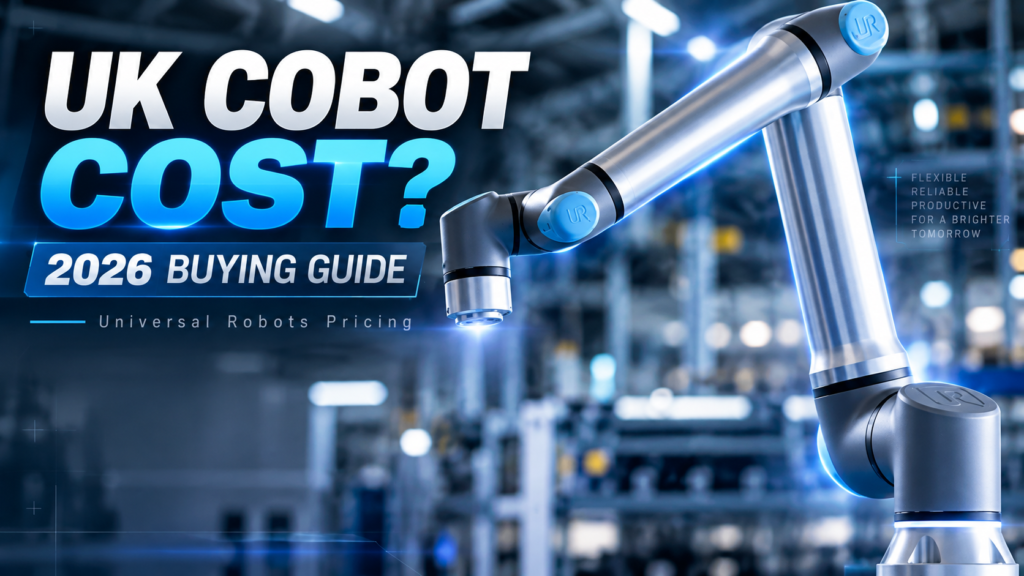
Quick answer: what does a cobot cost in the UK? A collaborative robot arm costs roughly £18,000 to £65,000+ in 2026, depending on payload and reach. But the arm is only part of the bill: once you add a gripper, safety, integration, programming and training, most complete UK cobot cells land between £35,000 and £90,000. Smaller, simple tasks (machine tending, screwdriving, packing) sit at the lower end. Palletising, welding and heavy-payload work sit at the top. Most well-scoped projects pay back in 12 to 24 months. Robot Center can give you an accurate all-in quote for your application.
How much does a cobot arm cost in the UK in 2026?
The table below shows indicative UK price bands for the arm itself, using Universal Robots, the market benchmark, as the reference range. Other brands, including Elite Robots and a growing field of challengers, often price lower for comparable payloads. Prices are indicative and exclude VAT, tooling and integration.
| Payload class | Typical models | Reach | Indicative arm price (ex VAT) |
|---|---|---|---|
| 3 kg | UR3e | 500 mm | £18,000 – £24,000 |
| 5 kg | UR5e | 850 mm | £24,000 – £35,000 |
| 10 kg | UR10e | 1,300 mm | £35,000 – £47,000 |
| 16 kg | UR16e | 900 mm | £45,000 – £52,000 |
| 20–30 kg | UR20, UR30 | 1,750 mm (UR20) | £50,000 – £68,000+ |
As a rule of thumb, the arm is around 50 to 70 percent of a typical basic deployment. The rest is everything that makes it actually do useful work.
What does a complete cobot cell really cost?
This is the number that matters, and the one most quotes bury. Budget for these on top of the arm:
-
- Gripper or end-of-arm tooling: roughly £1,500 to £8,000 for standard parallel, vacuum or adaptive grippers, more for custom tooling.
-
- Vision and sensing: around £2,000 to £6,000 for 2D or 3D cameras and force/torque sensors, if your task needs them.
-
- Safety: safety scanners, light curtains or guarding, depending on the risk assessment. A cobot is not automatically safe, because the tool and the workpiece can still be hazardous.
-
- Integration and programming: often £4,000 to £15,000+ for workcell layout, PLC and network connection, and programming. Complex applications can cost as much as the robot itself.
-
- Fixtures, feeders, conveyors and pallets: the mechanical items around the robot.
-
- Training and support: operator and maintenance training, plus a support agreement.
Put together, expect £35,000 to £90,000 for most UK cells, and up to £150,000 or more for multi-station or heavily customised systems.
Buy, lease or Robotics-as-a-Service: which is cheaper?
Buying outright is cheapest over five years or more if you have steady, long-term work for the robot. But it needs the most capital up front. Leasing or financing spreads the cost and can keep the spend off your capital budget. Robotics-as-a-Service (RaaS) bundles the robot, support and upgrades into a monthly fee, which suits businesses that want low upfront cost and predictable budgeting. Short-term rental is a low-risk way to prove an application before committing. Robot Center offers Robotics-as-a-Service, and short-term hire is available through sister company Robots of London. For a wider view of costs across service robots, see our service robot cost guide, and our Mirokaï price guide for hospitality.
How long does a cobot take to pay for itself?
Most well-scoped cobot projects pay back in 12 to 24 months. The fastest paybacks come from repetitive tasks running across multiple shifts, such as machine tending, palletising, packing, screwdriving and quality inspection. To estimate yours, divide the total cell cost by the annual saving (labour hours freed, scrap reduced and throughput gained). Do not forget that a cobot can run through breaks and second shifts.
Cobot or traditional industrial robot: which costs less?
A traditional industrial arm can look cheaper on the price list, but it usually needs safety fencing, specialist programming and a fixed installation, which can add tens of thousands of pounds. Cobots are quicker to deploy, easier to redeploy between jobs and can often work without full guarding after a risk assessment. For high-speed, high-volume, single-purpose work, an industrial robot may still win. For flexible, mixed or lower-volume work, cobots usually give the better total cost.
How to keep your cobot cost down
-
- Start with one clearly defined task rather than a plant-wide programme.
-
- Match payload and reach to the job. Paying for a UR20 when a UR5e will do is the most common overspend.
-
- Ask for a fixed-scope, all-in quote covering tooling, safety, integration and training.
-
- Compare purchase, lease and RaaS on total cost over your expected lifetime.
-
- Check for support and spares in the UK before you buy.
Frequently asked questions
How much does a cobot cost in the UK?
Between £18,000 and £65,000+ for the arm alone, and typically £35,000 to £90,000 for a complete, working cell in 2026.
What is the cheapest cobot?
Lower-payload arms from challenger brands can start well below £15,000. Established brands such as Universal Robots start around £18,000 for the UR3e. Cheap arms can still cost more overall if support, safety and integration are weak, so compare the full package.
Are cobots worth it for small businesses?
Yes, where a task is repetitive and runs for many hours. Leasing or RaaS lowers the barrier, and a 12 to 24 month payback is common.
Can I rent or lease a cobot?
Yes. Leasing, financing, RaaS and short-term rental pilots are all available in the UK, and Robot Center can advise on the right route.
Do cobots need safety fencing?
Often not, but it depends on your risk assessment. The tool, the part being handled and the speed of operation all affect the safety design.
Get an accurate cobot quote
Every application is different, so the fastest way to a real number is a short conversation about your task, cycle time and site. Contact Robot Center, the UK & Ireland specialist in service and industrial robotics, for a clear, all-in quote and a view on whether purchase, lease or RaaS fits your budget best.