

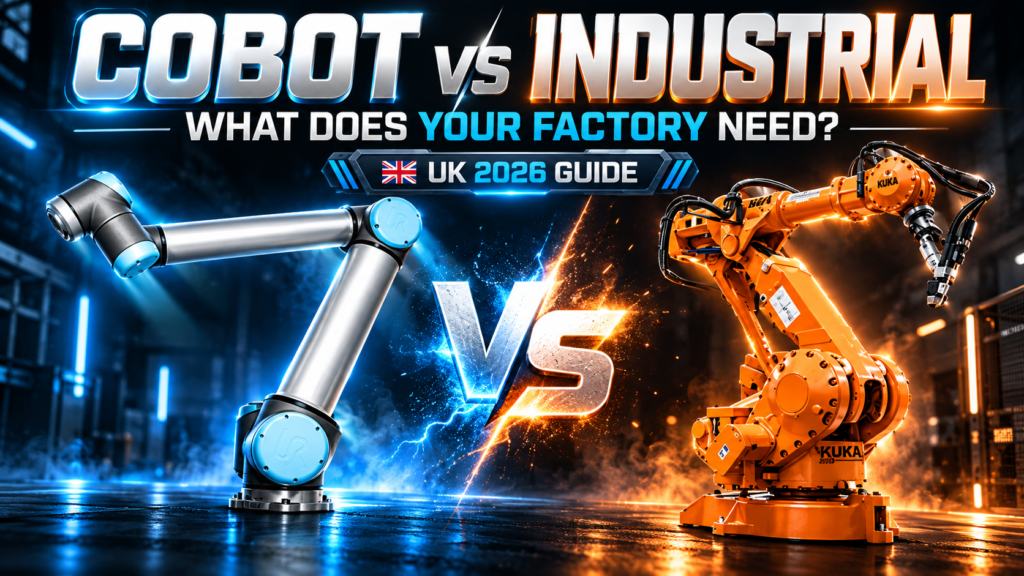
Every UK manufacturer looking at automation hits the same fork in the road: do you buy a collaborative robot (cobot) that works alongside your people, or a traditional industrial robot arm that works behind a fence at full speed? Pick wrong and you either overspend on guarding and integration you didn’t need, or you buy a cobot that can’t keep up with your line. This guide compares cobot vs industrial robot on cost, speed, payload, safety, footprint and payback, so you can make the right call in 2026.
Quick answer: cobot or industrial robot? Choose a cobot if your payload is under about 30 kg, cycle times are moderate, floor space is tight, product changeovers are frequent, or people need to work next to the robot. A complete UK cobot cell typically costs £35,000–£90,000 and often pays back in 12–24 months. Choose an industrial robot if you need very high speed, heavy payloads (from roughly 30 kg up to over a tonne), long reach, or 24/7 high-volume output of a single product — but budget for guarding, safety systems and specialist integration, which usually pushes a full cell to £80,000–£250,000+. Many factories end up with both. Robot Center can assess your application and quote either route.
What is the difference between a cobot and an industrial robot?
Both are articulated robot arms that pick, place, weld, pack, tend machines and palletise. The difference is how they are designed to share space with people.
-
- A cobot (such as the Universal Robots e-Series and UR20/UR30) has built-in force and torque sensing, rounded surfaces and speed and force limits. When it detects an unexpected contact, it stops. After a proper risk assessment, many cobot applications can run with little or no fencing.
-
- An industrial robot (from makers such as FANUC, ABB, KUKA and Yaskawa) is built for maximum speed, payload and precision. It does not limit itself around people, so it normally runs inside a guarded cell with fencing, interlocked doors, light curtains or area scanners.
One important nuance: a cobot isn’t automatically “safe”. It’s the application that is collaborative or not. A cobot carrying a sharp blade or a hot weld torch still needs safeguarding. Every deployment needs a risk assessment under ISO 10218 and, for collaborative operation, the guidance in ISO/TS 15066.
Cobot vs industrial robot: side-by-side comparison
| Factor | Cobot (e.g. Universal Robots) | Industrial robot arm |
|---|---|---|
| Typical payload | 3–30 kg | From a few kg up to 1,000 kg+ |
| Speed | Moderate; reduced further when people are close | Very high, full speed all the time |
| Safety approach | Built-in force limiting plus risk assessment; often minimal guarding | Fencing, interlocks, light curtains or scanners |
| Floor space | Small; can sit on a bench or mobile stand | Larger; guarded cell footprint |
| Programming | Teach pendant, hand-guiding, drag-and-drop | Usually specialist programmers or integrators |
| Redeployment | Easy to move between jobs | Usually fixed in one cell |
| Robot arm price (UK, 2026) | ~£18,000–£65,000 | ~£25,000–£100,000+ |
| Full cell cost (UK, 2026) | ~£35,000–£90,000 | ~£80,000–£250,000+ |
| Typical payback | 12–24 months | 18–36 months (faster at very high volumes) |
| Best for | SMEs, high-mix/low-volume, shared workspaces | High-volume, heavy, fast, single-product lines |
Cobot vs industrial robot cost: which is cheaper?
On the arm alone, the gap can be smaller than people expect. The real difference is everything around the arm.
With a cobot, a typical UK project adds a gripper or end-effector, a stand or bench, safety assessment, programming and training. That usually lands a complete cell between £35,000 and £90,000. (We break this down in detail in our 2026 cobot cost guide.)
With an industrial robot, you add perimeter fencing, interlocked access doors, safety PLCs, light curtains or scanners, and more intensive integration and programming. Those costs are what push full industrial cells well into six figures. The upside is throughput: if the robot runs flat-out across three shifts on one product, the cost per part can end up lower than a cobot’s.
If upfront cost is the blocker, both routes can be financed. Cobots in particular suit Robotics-as-a-Service (RaaS) and leasing, which turn a capital purchase into a monthly operating cost.
Cobot vs industrial robot speed: is a cobot fast enough?
For most SME tasks, yes. Machine tending, packing, screwdriving, inspection, labelling and end-of-line palletising rarely need the robot to be the bottleneck. Your CNC cycle, your conveyor or your operator usually sets the pace.
Where cobots struggle is high-speed pick-and-place, press tending at very short cycle times, or anything where a second shaved off each cycle is worth tens of thousands of pounds a year. That is industrial robot territory.
A useful middle ground: many cobot applications run at higher speed when nobody is nearby and slow down automatically when an area scanner detects a person. That gets you closer to industrial speeds without a full fence.
What payload do you actually need?
Remember that payload includes the gripper, not just the part. A 6 kg box with a 3 kg vacuum gripper is a 9 kg payload. Universal Robots covers most SME needs:
-
- UR3e (3 kg) – benchtop assembly, small-part handling, lab work
-
- UR5e (5 kg) – machine tending, light pick-and-place, screwdriving
-
- UR10e (12.5 kg) – packing, larger machine tending, light palletising
-
- UR16e (16 kg) – heavier handling with a shorter reach
-
- UR20 (20 kg) and UR30 (30 kg) – palletising, heavy machine tending, welding
Once you are consistently above 30 kg — engine blocks, full sacks, large castings, heavy pallets at speed — you need an industrial robot.
Cobot vs industrial robot safety: do cobots need fencing?
Often not — but it depends on the risk assessment, not the robot’s label. A cobot tending a CNC machine with a soft gripper may run completely unguarded. The same cobot moving sharp sheet metal or working at face height may need scanners, reduced speeds or partial guarding.
Industrial robots almost always need a full guarded cell. That affects cost, floor space, and how easily operators can load parts or clear jams.
Which is easier to program and redeploy?
Cobots win clearly here. Collaborative robots from Universal Robots can be taught by physically moving the arm and using a tablet-style pendant, and there’s a large ecosystem of plug-and-play grippers, vision systems and software (UR+). Your own staff can usually learn to make routine changes after a short training course.
That matters most for high-mix, low-volume manufacturers. If you change product weekly, a cobot on a mobile stand can move from machine tending on Monday to packing on Thursday. Industrial robots are usually programmed by integrators and stay put in one cell for years.

Cobot vs industrial robot: which should you choose?
Choose a cobot if:
-
- Your payload (including gripper) is under 30 kg
-
- Cycle times are moderate and the robot won’t be the bottleneck
-
- Floor space is limited or people need to work nearby
-
- You make many products in small batches
-
- This is your first automation project and you want a lower-risk entry point
Choose an industrial robot if:
-
- You need heavy payloads, long reach or very high speed
-
- You run one product at high volume, often across multiple shifts
-
- The process is hazardous regardless (high-power welding, foundry, heavy press work)
-
- You have the space and budget for a fully guarded cell
And don’t forget the third option: pair a cobot with an autonomous mobile robot (AMR) such as a MiR250 or MiR600 to move parts between cells. See our MiR AMR price guide for how that works.
Frequently asked questions
Are cobots cheaper than industrial robots?
Usually, once you count the whole cell. In a cobot vs industrial robot cost comparison, the arms can be similarly priced, but cobots typically need less guarding and simpler integration, so a complete cobot cell (£35,000–£90,000) generally costs less than a full industrial cell (£80,000–£250,000+).
Can a cobot replace an industrial robot?
For light-to-medium tasks at moderate speed, often yes. For heavy payloads, very fast cycles or harsh environments, no — an industrial robot remains the right tool.
Are cobots completely safe to work next to?
Cobots are designed to limit force on contact, but safety depends on the whole application. Every installation needs a risk assessment, and some cobot cells still need scanners or guarding.
How long does it take to install a cobot?
A straightforward cobot application can be up and running in days to a few weeks. Industrial robot cells, with guarding and more complex integration, typically take several weeks to a few months.
Can I lease or rent a cobot in the UK?
Yes. Robot Center offers purchase, leasing and Robotics-as-a-Service options on Universal Robots cobots, so you can automate without a large upfront capital outlay.
Get expert advice from Robot Center
Still weighing up cobot vs industrial robot for your line? Robot Center supplies Universal Robots cobots and MiR autonomous mobile robots across the UK and Ireland, and we’ll give you an honest recommendation — even if that means a different kind of robot. Contact Robot Center for a free application review and an all-in quote.