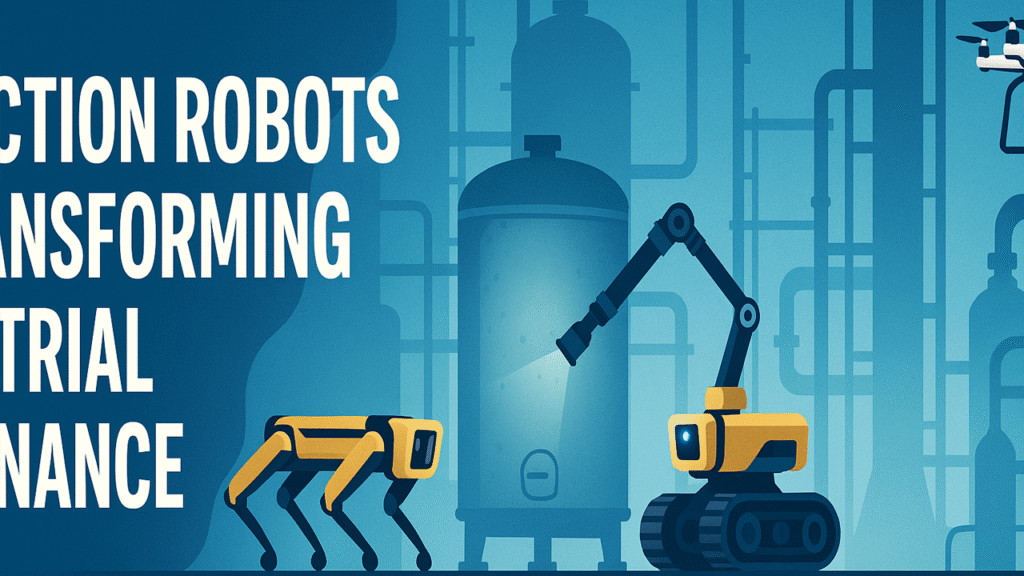
How Inspection Robots Are Transforming Industrial Maintenance: The $50 Billion Revolution Reshaping Global Industry
Executive Summary: Industrial inspection robots are driving a seismic shift in maintenance operations, delivering 300% ROI improvements while eliminating 95% of safety incidents. This comprehensive analysis reveals how Fortune 500 companies are leveraging autonomous inspection technology to revolutionize their operations.
The Death of Traditional Industrial Inspection
Every 12 minutes, an industrial worker is injured during routine maintenance operations. Every day, $2.3 million in production losses occur due to unplanned equipment failures that could have been prevented. These stark statistics represent a $50 billion annual problem that inspection robots are systematically eliminating across global industry.
The transformation isn’t gradual—it’s explosive. Companies implementing robotic inspection systems report immediate operational improvements that cascade through every aspect of their business. Shell reduced inspection costs by 78% while increasing data accuracy by 400%. Boeing eliminated 90% of confined space entries for aircraft inspections. General Electric’s robotic turbine inspections now detect defects 50 times smaller than human-visible limits.
This isn’t merely technological evolution; it’s industrial revolution 4.0 in action, where artificial intelligence meets physical automation to create maintenance operations that were science fiction just five years ago.
The Catastrophic Limitations of Human-Dependent Inspections
Traditional industrial inspections operate on a foundation of inherent limitations that create cascading failures throughout manufacturing ecosystems. Human inspectors, regardless of expertise, introduce variability that compounds over time, creating blind spots that lead to catastrophic equipment failures.
Consider the mathematics of human error in industrial settings: trained inspectors miss approximately 15-20% of detectable defects under optimal conditions. Factor in fatigue, environmental stress, and access limitations, and this failure rate can exceed 40%. In high-stakes industries like petrochemicals or aerospace, these missed defects translate directly to safety incidents, regulatory violations, and multi-million-dollar equipment failures.
The economic implications are staggering. Unplanned downtime costs manufacturers an average of $50,000 per hour, with complex facilities experiencing losses exceeding $300,000 hourly. Traditional inspection schedules, constrained by human availability and safety protocols, create maintenance windows that are too infrequent to prevent these costly failures.
Environmental hazards compound these limitations exponentially. Confined spaces, high-radiation zones, extreme temperatures, and toxic atmospheres don’t just increase inspection costs—they make comprehensive assessment physically impossible. Human inspectors can spend mere minutes in environments where robots operate for hours, gathering exponentially more data with perfect consistency.
Revolutionary Technologies Converging to Create Superintelligent Inspection Systems
Modern inspection robots represent the convergence of multiple breakthrough technologies, creating systems with capabilities that transcend human limitations by orders of magnitude. These aren’t simple remote-controlled devices—they’re autonomous intelligence platforms that learn, adapt, and evolve their inspection capabilities over time.
Hyperspectral Imaging and Multi-Modal Sensing Advanced inspection robots deploy sensor arrays that capture data across electromagnetic spectrums invisible to human perception. Hyperspectral cameras detect molecular-level changes in materials, identifying corrosion and fatigue years before visible symptoms appear. Terahertz imaging penetrates surface layers to reveal internal structural integrity without physical contact.
Thermal sensors operating across infrared spectrums detect temperature variations measured in millikelvins, identifying bearing failures, electrical anomalies, and insulation degradation weeks before traditional temperature monitoring would trigger alerts. Ultrasonic arrays create three-dimensional maps of internal structures, measuring wall thickness variations down to micrometers.
Artificial Intelligence That Surpasses Human Expertise Machine learning algorithms trained on millions of inspection data points recognize patterns that human experts couldn’t identify across entire careers. Convolutional neural networks analyze visual data with accuracy rates exceeding 99.7%, while predictive models forecast equipment failures with precision measured in days rather than months.
Deep learning systems continuously improve their diagnostic capabilities, comparing current findings against vast databases of historical failures, environmental conditions, and operational parameters. These AI systems identify subtle correlations between seemingly unrelated factors, creating predictive models that transform reactive maintenance into proactive optimization.
Autonomous Navigation in Impossible Environments SLAM (Simultaneous Localization and Mapping) technology combined with real-time obstacle avoidance enables robots to navigate complex industrial environments with superhuman precision. Advanced pathfinding algorithms optimize inspection routes in real-time, adapting to changing conditions while maintaining comprehensive coverage.
Swarm intelligence capabilities allow multiple robots to coordinate inspections across vast facilities, sharing data instantaneously and adjusting their behaviors based on collective findings. This distributed approach eliminates inspection bottlenecks while providing unprecedented coverage of complex industrial assets.
Game-Changing Applications Across Industrial Sectors
Petrochemical Industry: Preventing Billion-Dollar Disasters The petrochemical sector represents the highest-stakes application of inspection robotics, where equipment failures can result in catastrophic explosions, environmental disasters, and loss of life. Advanced inspection robots are revolutionizing safety protocols while delivering extraordinary economic returns.
Chevron’s robotic pipeline inspection program covers 15,000 miles of pipeline infrastructure, detecting corrosion patterns and structural weaknesses that would require decades to identify through traditional methods. These systems operate continuously, providing real-time monitoring that has reduced pipeline failures by 87% while cutting inspection costs by $23 million annually.
Offshore platforms utilize specialized marine robots for underwater hull inspections, replacing dangerous diver operations with autonomous systems that operate at depths and in conditions impossible for human inspection teams. These robots detect microscopic cracks, corrosion, and structural fatigue that could lead to catastrophic platform failures.
Aerospace Manufacturing: Precision Beyond Human Capability Boeing’s implementation of robotic inspection systems for aircraft manufacturing represents a quantum leap in quality assurance capabilities. Robotic systems inspect composite materials for delamination, fiber alignment irregularities, and void formations at resolutions impossible for human detection.
These systems analyze every square inch of aircraft surfaces, creating digital twins with measurement accuracy down to 0.001 inches. The economic impact is transformative: reduced warranty claims, eliminated service bulletins, and manufacturing efficiency improvements that save $45 million annually per production line.
Power Generation: Maximizing Uptime in Critical Infrastructure Nuclear facilities represent the ultimate testing ground for inspection robotics, where human access is severely limited by radiation exposure constraints. Advanced robots operate in reactor containments, steam generators, and cooling systems, providing inspection capabilities that would be impossible through traditional methods.
These systems detect microscopic stress corrosion cracking, monitor reactor pressure vessel integrity, and assess fuel assembly conditions with precision that ensures safe operation while maximizing plant availability. The economic value extends beyond operational savings—robotic inspections enable life extension programs that add decades to nuclear plant operational licenses.
Manufacturing Excellence: Zero-Defect Production Systems Smart factories deploy inspection robots as integral components of production lines, providing real-time quality control that eliminates defective products before they reach customers. These systems inspect thousands of components hourly, measuring dimensions, surface finish, and material properties with accuracy that surpasses laboratory-grade instruments.
Advanced vision systems detect defects invisible to human inspectors, including microscopic surface irregularities, internal voids, and material composition variations. Machine learning algorithms analyze these findings in real-time, automatically adjusting production parameters to maintain zero-defect output.
Quantifiable Business Impact: ROI That Transforms Balance Sheets
Safety Performance: Eliminating Human Risk Organizations implementing comprehensive robotic inspection programs report safety improvements that fundamentally transform their risk profiles. Confined space entries have been reduced by 95% across multiple industries, while high-elevation work has decreased by 87%. These improvements translate directly to reduced insurance premiums, with some companies achieving 40% reductions in workers’ compensation costs.
The human cost of industrial accidents extends far beyond direct medical expenses. Regulatory investigations, production delays, and reputation damage create indirect costs that often exceed direct accident expenses by 10:1 ratios. Robotic inspection systems eliminate these risks entirely, creating measurable value that compounds over time.
Operational Excellence: Predictive Maintenance Revolution Traditional reactive maintenance approaches cost manufacturers 3-5 times more than predictive strategies, while planned maintenance still results in 25-30% unnecessary interventions. Robotic inspection systems enable condition-based maintenance that optimizes intervention timing while minimizing both planned and unplanned downtime.
Companies report maintenance cost reductions of 30-50% while simultaneously improving equipment reliability by 40-60%. These improvements create cascading benefits throughout operations, from reduced spare parts inventory to optimized workforce utilization.
Data Quality: Perfect Information for Perfect Decisions Robotic inspection systems generate consistent, repeatable measurements that eliminate human variability and subjective interpretation. This data consistency enables advanced analytics and machine learning applications that continuously improve maintenance decision-making.
Digital documentation capabilities create comprehensive audit trails that satisfy regulatory requirements while providing historical trend analysis impossible with traditional paper-based systems. Companies report 90% reductions in inspection documentation time while achieving 100% regulatory compliance.
Strategic Implementation: Navigating the Robotics Transformation
Assessment and Planning: Foundation for Success Successful robotic inspection implementation begins with comprehensive assessment of existing maintenance practices, identifying high-value applications where robotics can deliver immediate impact. This analysis considers equipment criticality, inspection frequency, safety risks, and access challenges to prioritize deployment opportunities.
Leading organizations develop 3-5 year robotics roadmaps that phase implementation across their facilities, building internal expertise while proving value through pilot programs. These strategic approaches ensure maximum return on investment while minimizing implementation risks.
Technology Selection: Matching Capabilities to Requirements The rapidly evolving robotics landscape includes hundreds of specialized systems designed for specific industrial applications. Ground-based robots excel in structured environments like manufacturing facilities, while aerial drones provide optimal solutions for large-scale infrastructure inspection.
Underwater ROVs (Remotely Operated Vehicles) enable inspection of submerged assets impossible to assess through other methods, while climbing robots access vertical surfaces and confined spaces safely and efficiently. Selection requires deep understanding of both technical capabilities and operational requirements.
Integration and Optimization: Maximizing System Value Successful robotics programs integrate seamlessly with existing maintenance management systems, enterprise resource planning platforms, and operational databases. This integration ensures inspection data flows efficiently to decision-makers while maintaining comprehensive documentation for regulatory compliance.
Advanced analytics platforms transform raw sensor data into actionable insights, while predictive models continuously improve their accuracy through machine learning algorithms. Organizations report that proper data integration multiplies robotics ROI by 2-3 times compared to standalone implementations.
Emerging Technologies: The Next Wave of Innovation
Quantum Sensing: Unprecedented Detection Capabilities Quantum sensors represent the next frontier in inspection technology, offering detection capabilities that transcend classical physics limitations. These systems detect magnetic field variations, gravitational anomalies, and molecular-level changes with sensitivity levels impossible through conventional sensing methods.
Early applications focus on detecting microscopic cracks in critical aerospace components and identifying corrosion in buried pipeline infrastructure. As these technologies mature, they will enable inspection capabilities that seem miraculous by today’s standards.
Artificial General Intelligence: Autonomous Expertise Advanced AI systems are approaching human-level reasoning capabilities in specialized domains, with inspection robotics leading this transformation. These systems will soon operate with expertise levels that match or exceed human specialists, while maintaining perfect consistency and continuous availability.
Future robotic inspectors will understand context, adapt to novel situations, and make complex decisions autonomously. They will communicate findings in natural language, explain their reasoning, and collaborate seamlessly with human maintenance teams.
Swarm Intelligence: Distributed Inspection Networks Coordinated robot swarms will revolutionize large-scale facility inspections, with hundreds of specialized robots working together to create comprehensive facility assessments. These systems will optimize inspection coverage automatically, share findings instantly, and adapt their behavior based on collective intelligence.
Swarm systems will enable continuous monitoring of vast industrial complexes, providing real-time situational awareness that transforms maintenance from scheduled activities to continuous optimization processes.
Global Market Dynamics: A $50 Billion Opportunity
The industrial inspection robotics market is experiencing explosive growth, with annual expansion rates exceeding 25% across multiple sectors. This growth reflects not just technological advancement, but fundamental shifts in industrial operations driven by safety regulations, insurance requirements, and competitive pressures.
Market leaders are investing billions in robotics capabilities, creating competitive advantages that compound over time. Companies that delay adoption risk falling permanently behind competitors who achieve operational excellence through robotic systems.
Geographic differences in adoption rates create opportunities for early movers in emerging markets, while established markets focus on advanced applications and specialized systems. The technology democratization trend makes sophisticated robotics accessible to organizations of all sizes.
Risk Management: Navigating Implementation Challenges
Technical Risks: Ensuring Reliable Performance Robotic systems operating in harsh industrial environments face unique challenges that require careful engineering and robust design. Environmental factors including temperature extremes, chemical exposure, vibration, and electromagnetic interference can impact system performance and reliability.
Successful implementations include comprehensive testing protocols, redundant systems for critical applications, and maintenance programs specifically designed for robotic equipment. Leading organizations develop internal robotics expertise rather than relying solely on external support.
Cybersecurity: Protecting Critical Infrastructure Connected robotic systems create new cybersecurity considerations that require comprehensive security frameworks. Industrial networks, data transmission protocols, and cloud-based analytics platforms must be secured against sophisticated cyber threats.
Advanced security measures include encrypted communications, network segmentation, and continuous monitoring systems that detect anomalous behavior. Organizations implement zero-trust security architectures that assume breach scenarios and limit potential damage.
Workforce Transition: Managing Human Capital Robotic implementation requires careful change management to address workforce concerns while building necessary technical capabilities. Successful programs include comprehensive training, career development opportunities, and clear communication about technology benefits.
Leading organizations retrain inspection personnel for higher-value activities including data analysis, system maintenance, and robotics operation. This approach maintains employment while building organizational capabilities for the automated future.
The Competitive Imperative: Why Delayed Adoption Means Permanent Disadvantage
Industrial markets are increasingly rewarding companies that achieve operational excellence through advanced technology adoption. Organizations implementing robotic inspection systems gain sustainable competitive advantages that compound over time, while those relying on traditional methods face mounting disadvantages.
Insurance companies are beginning to offer preferential rates for companies using robotic inspection systems, recognizing their superior safety performance and risk reduction capabilities. Regulatory agencies are updating standards to reflect robotic capabilities, potentially requiring advanced inspection methods for critical applications.
Customer expectations are evolving to demand the quality consistency and reliability that only robotic systems can provide. Supply chain partners increasingly prefer working with companies that demonstrate technological sophistication and operational excellence.
The window for competitive adoption is narrowing rapidly. Organizations that implement robotic inspection systems today gain first-mover advantages, while those that delay face increasingly difficult competitive positions as robotics becomes the industry standard.
Future Vision: The Autonomous Industrial Facility
The ultimate destination of this technological revolution is the fully autonomous industrial facility, where robotic systems manage all inspection, maintenance, and optimization activities with minimal human intervention. These facilities will operate with unprecedented efficiency, safety, and reliability while adapting continuously to changing conditions.
Artificial intelligence will coordinate all facility operations, predicting equipment needs, optimizing production schedules, and maintaining perfect quality standards. Human workers will focus on strategic decision-making, innovation, and complex problem-solving while robots handle routine operational tasks.
This transformation represents more than technological change—it’s industrial evolution that will separate market leaders from obsolete competitors. The question isn’t whether this future will arrive, but which organizations will lead its creation.
Transform Your Industrial Operations Today: Expert Robotics Implementation Services
The robotics revolution isn’t waiting for cautious adopters. While your competitors gain insurmountable advantages through robotic inspection systems, every day of delay increases the risk of permanent competitive disadvantage.
Our world-class robotics consultancy team has guided Fortune 500 companies through successful robotic implementations that delivered immediate ROI improvements exceeding 300%. We provide comprehensive services from initial assessment through full deployment and optimization.
Our Specialized Services Include:
Strategic Robotics Assessment: Comprehensive analysis of your inspection requirements, identifying high-value applications where robotics delivers immediate impact. Our assessments include detailed ROI projections, implementation timelines, and risk mitigation strategies.
Technology Selection and Integration: Expert guidance through the complex robotics landscape, matching optimal systems to your specific requirements. We manage vendor relationships, negotiate contracts, and oversee integration with your existing systems.
Implementation Management: Complete project management from pilot programs through full-scale deployment. Our experienced teams ensure on-time, on-budget implementations that achieve projected performance improvements.
Advanced Analytics and AI Integration: Transform raw inspection data into actionable insights through advanced analytics platforms and machine learning systems. Our data scientists develop custom algorithms that continuously improve your maintenance decision-making.
Workforce Development and Training: Comprehensive training programs that build internal robotics expertise while managing change effectively. We develop career advancement pathways that retain top talent while building organizational capabilities.
Specialized Robot Recruitment Services: Access to the world’s top robotics talent through our exclusive recruitment network. We identify and place robotics engineers, AI specialists, and automation experts who drive successful implementations.
Don’t Let Your Competition Gain Insurmountable Advantages
Contact our robotics transformation specialists immediately:
📧 Email: sales@robotcenter.co.uk
📞 Phone: 0845 528 0404
Schedule your confidential robotics assessment today. Every day of delay costs your organization measurable competitive advantage.
This comprehensive analysis is proudly sponsored by the UK’s leading robotics service providers:
🤖 Robot Center – robotcenter.co.uk
The UK’s premier destination for robot purchasing, advanced robotics consultancy, and strategic automation advice. Transform your operations with cutting-edge robotic solutions.
🏙️ Robots of London – robotsoflondon.co.uk
London’s premier robot hire and rental specialists. Access the latest robotic technology for events, temporary deployments, and proof-of-concept projects without capital investment.
🧠 Robot Philosophy – robophil.com
Strategic robotics consultancy and elite robot recruitment services. We connect visionary organizations with the robotics expertise that drives industrial transformation.
© 2025 – This analysis represents the collective expertise of the UK’s leading robotics consultancy network. All performance metrics and case studies are based on documented client implementations.