

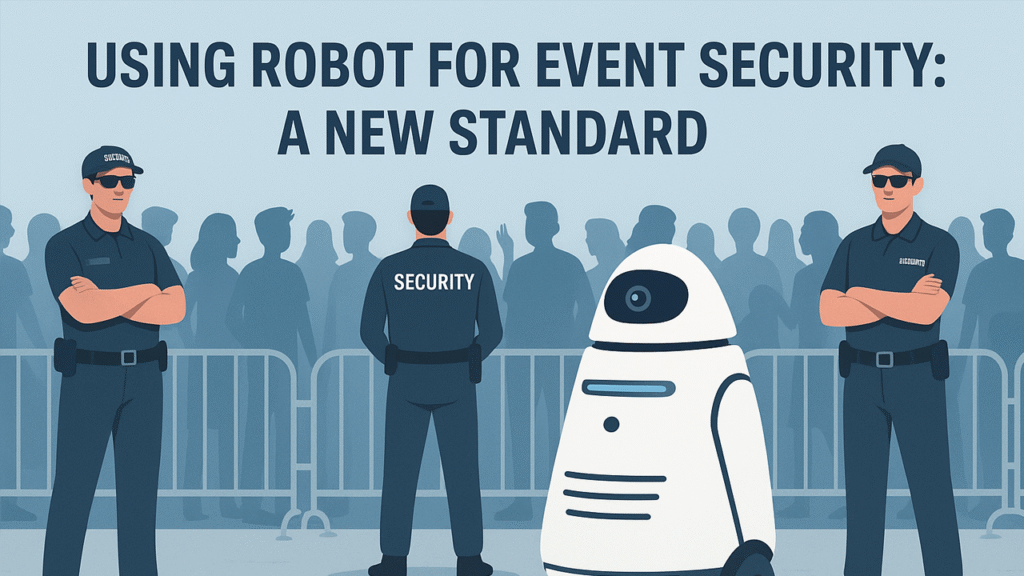
Using Robots for Event Security: A New Standard
The landscape of event security is undergoing a revolutionary transformation. As we move deeper into 2025, the integration of robotic technology in security operations has shifted from experimental innovation to essential infrastructure. Major venues across the globe are discovering that robotic security solutions offer unprecedented capabilities that traditional human-only security teams simply cannot match.
The Evolution of Event Security Challenges
Modern events face security challenges that would have been unimaginable just a decade ago. From large-scale festivals accommodating hundreds of thousands of attendees to intimate corporate gatherings requiring discrete yet comprehensive protection, the complexity of security requirements has grown exponentially. Traditional security approaches, while valuable, are increasingly strained by factors including:
Scale and Coverage Limitations: Human security personnel, regardless of their expertise, face physical limitations in coverage area and sustained attention. Large venues require extensive coordination between multiple teams, creating potential gaps in surveillance and response capabilities.
Cost Escalation: The rising costs of trained security personnel, particularly for extended events or multiple-day festivals, present significant budget challenges for event organizers. Premium security services can consume substantial portions of event budgets, often requiring difficult trade-offs between security coverage and other essential services.
Consistency and Reliability: Human performance naturally varies throughout extended shifts. Fatigue, distraction, and the inherent limitations of human attention span can create vulnerabilities during critical moments when consistent vigilance is most needed.
Technology Integration Challenges: Modern security systems generate vast amounts of data from CCTV networks, access control systems, and environmental sensors. Processing and responding to this information in real-time requires capabilities that exceed typical human processing speeds.
Robotic Security: Beyond Science Fiction
The deployment of robots in security applications has evolved far beyond the realm of science fiction. Today’s security robots represent sophisticated integration of artificial intelligence, advanced sensor technology, and autonomous navigation systems. These platforms offer capabilities that complement and enhance human security teams rather than replacing them entirely.
Autonomous Patrol Capabilities: Modern security robots can navigate complex environments independently, following predetermined routes while adapting to dynamic obstacles and changing conditions. Their patrol patterns can be optimized in real-time based on crowd density, identified risk areas, and specific event requirements.
Multi-Spectrum Surveillance: Unlike human security personnel who rely primarily on visual observation, security robots incorporate multiple sensor types including thermal imaging, motion detection, sound analysis, and even chemical detection capabilities. This multi-layered approach to environmental monitoring provides comprehensive situational awareness that significantly exceeds human sensory limitations.
Continuous Operation: Security robots operate continuously without breaks, shift changes, or performance degradation due to fatigue. This consistency ensures uninterrupted security coverage throughout entire events, regardless of duration or complexity.
Data Integration and Analysis: Perhaps most significantly, security robots can process and correlate information from multiple sources simultaneously. They can integrate feeds from existing security infrastructure, analyze patterns in real-time, and identify potential security concerns before they escalate into serious incidents.
Practical Applications in Event Security
The practical deployment of robotic security systems has proven successful across diverse event types and scales. Each application demonstrates unique advantages that traditional security approaches struggle to match.
Perimeter Security and Access Control: Security robots excel in perimeter monitoring, providing consistent surveillance of venue boundaries and access points. Their ability to operate in challenging environmental conditions, including low light situations and adverse weather, ensures reliable perimeter security regardless of external factors. Advanced facial recognition and credential verification systems allow for sophisticated access control that can adapt to different security clearance levels throughout an event.
Crowd Monitoring and Analysis: Large events present complex crowd dynamics that can rapidly evolve from manageable to dangerous. Security robots equipped with advanced analytics can monitor crowd density, identify forming bottlenecks, and detect unusual behavioral patterns that might indicate developing security concerns. This early warning capability allows security teams to implement preventive measures before situations escalate.
Emergency Response Coordination: During security incidents, robots can serve as mobile command centers, providing real-time information relay between different response teams. Their ability to quickly navigate to incident locations while maintaining communication links ensures that response teams have accurate, up-to-date information throughout emergency situations.
Asset Protection: High-value equipment, VIP areas, and restricted zones require consistent monitoring that security robots can provide with precision. Their ability to maintain exact positioning and monitor specific areas without deviation ensures that critical assets receive appropriate protection throughout events.
Integration with Human Security Teams
The most successful robotic security implementations recognize that robots and human security personnel offer complementary capabilities rather than competing alternatives. Human security professionals bring irreplaceable qualities including situational judgment, interpersonal communication skills, and adaptive problem-solving abilities that remain essential for comprehensive security operations.
Enhanced Situational Awareness: Robots serve as force multipliers for human security teams, providing them with enhanced information gathering and processing capabilities. Security personnel can make more informed decisions when supported by comprehensive data streams and analytical insights that robots provide.
Optimized Resource Allocation: By handling routine surveillance and monitoring tasks, robots allow human security personnel to focus on complex situations requiring judgment, interpersonal skills, and creative problem-solving. This optimization ensures that human expertise is applied where it provides maximum value.
Coordinated Response Capabilities: Advanced security robots can coordinate with human teams through sophisticated communication systems, providing real-time updates and receiving strategic direction. This integration creates hybrid security teams that leverage the strengths of both robotic and human capabilities.
Cost-Effectiveness and Return on Investment
While the initial investment in robotic security systems may appear substantial, the long-term cost-effectiveness becomes clear when evaluated against traditional security approaches over extended periods.
Operational Cost Reduction: Security robots eliminate many ongoing costs associated with human security teams including wages, benefits, training, and shift coverage requirements. For multi-day events or venues requiring consistent year-round security, these savings can be substantial.
Scalability Advantages: Robotic security systems can be scaled up or down based on specific event requirements without the complex logistics associated with hiring and training additional human personnel. This flexibility allows event organizers to optimize security coverage based on actual needs rather than personnel availability.
Risk Mitigation Value: The enhanced detection capabilities and consistent performance of security robots can significantly reduce the likelihood of security incidents that could result in substantial financial liability, reputation damage, or event cancellation costs.
Future Developments and Emerging Capabilities
The trajectory of robotic security technology continues to advance rapidly, with emerging capabilities that will further enhance their value in event security applications.
Artificial Intelligence Enhancement: Machine learning algorithms are enabling security robots to become more sophisticated in threat detection and behavioral analysis. These systems learn from each deployment, continuously improving their ability to identify potential security concerns and reduce false alarms.
Collaborative Robot Networks: Future deployments will likely feature networks of coordinated robots that can share information instantaneously and coordinate responses across large venues. This collective intelligence approach will provide comprehensive coverage that adapts dynamically to changing conditions.
Advanced Communication Integration: Emerging communication technologies will enable security robots to interface more seamlessly with existing security infrastructure, emergency services, and event management systems, creating truly integrated security ecosystems.
Implementation Considerations
Successfully implementing robotic security requires careful planning and consideration of specific venue and event requirements.
Venue Assessment: Each venue presents unique challenges and opportunities for robotic security deployment. Factors including layout complexity, crowd flow patterns, existing infrastructure, and specific security requirements must be thoroughly evaluated to optimize robot selection and deployment strategies.
Integration Planning: Successful implementation requires careful integration with existing security systems, personnel, and procedures. This includes training human security teams to work effectively with robotic systems and establishing clear protocols for coordinated operations.
Regulatory Compliance: Event security robots must comply with relevant regulations and standards, which may vary by jurisdiction and event type. Understanding and addressing these requirements is essential for successful deployment.
The Business Case for Robotic Security
Event organizers and venue operators are discovering that robotic security represents not just a technological upgrade, but a strategic business advantage. The combination of enhanced security capabilities, cost optimization, and operational flexibility creates compelling value propositions across multiple dimensions.
Enhanced Event Reputation: Events known for sophisticated, reliable security attract higher-quality attendees, premium sponsors, and positive media attention. The visible presence of advanced security technology can become a differentiating factor in competitive event markets.
Insurance and Liability Benefits: Many insurance providers recognize the risk reduction benefits of advanced security systems, potentially offering reduced premiums for events utilizing robotic security solutions. The documented performance and consistent operation of security robots can also provide valuable evidence in the event of security-related incidents.
Operational Efficiency: Beyond security functions, many security robots can provide additional services including way-finding assistance, crowd management support, and even basic customer service functions, maximizing their value contribution to overall event operations.
Professional Implementation and Support
The complexity of modern robotic security systems requires specialized expertise for optimal implementation and operation. Professional consulting services ensure that organizations can fully leverage the capabilities of robotic security while avoiding common implementation pitfalls.
System Design and Optimization: Professional consultants can assess specific venue and event requirements to design optimal robotic security solutions. This includes robot selection, deployment strategies, integration planning, and performance optimization to ensure maximum effectiveness.
Training and Support: Comprehensive training programs ensure that existing security teams can work effectively with robotic systems. Ongoing support services provide technical assistance, system updates, and performance optimization throughout deployment periods.
Recruitment and Staffing: As robotic security becomes more prevalent, organizations need personnel with specialized skills in robotics operation, maintenance, and integration. Professional recruitment services can identify and place qualified individuals who can manage and optimize robotic security systems.
The transformation of event security through robotic technology represents more than just technological advancement—it represents a fundamental shift toward more capable, cost-effective, and reliable security solutions. Organizations that embrace this transformation position themselves at the forefront of security innovation while achieving superior operational outcomes.
For event organizers, venue operators, and security professionals considering the integration of robotic security solutions, professional guidance ensures successful implementation and optimal results. The investment in expert consultation and support services pays dividends through enhanced security effectiveness, operational efficiency, and long-term cost optimization.
Ready to revolutionize your event security? Contact our expert team today to discuss how robotic security solutions can transform your operations. Our comprehensive consulting services and specialized recruitment capabilities ensure successful implementation tailored to your specific requirements.
Call us at 0845 528 0404 or email sales@robotcenter.co.uk to schedule your consultation.
About Our Sponsors
This article is proudly sponsored by leading organizations in robotic technology and services:
Robot Center – Your premier destination for robot acquisition and consultancy services. Whether you’re looking to buy robots or need expert robotics consultancy, Robot Center provides comprehensive solutions tailored to your specific requirements. Visit robotcenter.co.uk to explore their extensive range of robotic solutions and expert consulting services.
Robots of London – London’s premier robot hire and rental service provider. Specializing in robot events, Robots of London offers flexible rental solutions for temporary deployments, special events, and pilot programs. Their comprehensive hire services make advanced robotic technology accessible for organizations of all sizes. Discover their rental options at robotsoflondon.co.uk.
Robot Philosophy – Leading provider of strategic robot consultancy and specialized recruitment services. Robot Philosophy combines deep technical expertise with strategic business insight to help organizations navigate the complex landscape of robotic implementation. Their recruitment services connect organizations with top-tier robotic specialists. Learn more about their consulting and recruitment services at robophil.com.