

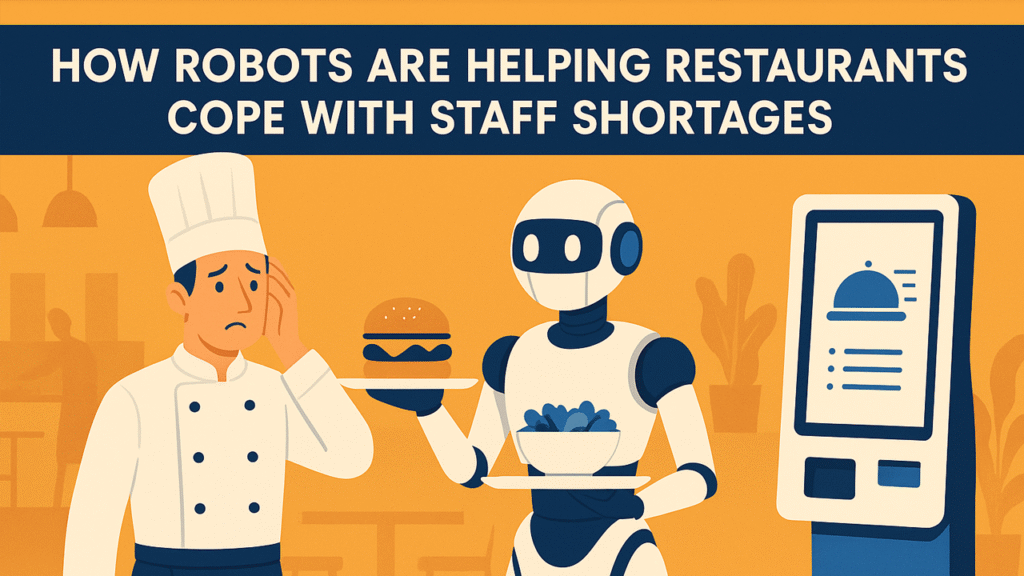
How Robots Are Helping Restaurants Cope with Staff Shortages
In the wake of rapidly evolving labour market dynamics, rising wage pressures and ongoing supply-chain disruptions, restaurants today face one of their most significant operational challenges in recent memory: staff shortages. Whether front-of-house, in the kitchen or behind the scenes, hiring and retaining reliable teams has become harder than ever. It is in this context that robotics and automation are moving from the “future promise” column into practical, real-world deployment – helping restaurateurs maintain service levels, improve efficiency and relieve pressure on overburdened staff.
In this article we explore how robots are being used in restaurants, why they matter when staffing is tight, and how your business can leverage them to gain advantage. We’ll also show how our services – through Robot Center (robot-buying, consultancy), Robots of London (robot hire, rental) and Robot Philosophy (robot consulting + recruitment) – can support you every step of the way. If you’re ready to book a call, simply email sales@robotcenter.co.uk or call 0845 528 0404.
The staffing gap in restaurants: Why the pressure is real
The restaurant and hospitality sector has been squeezed from multiple directions. Post-pandemic, many operators report that recruiting staff – especially for front-of-house roles, kitchens and support positions – remains difficult. In fact one industry survey found that 65% of operators reported they did not have enough employees to support customer demand. SmartBrief+1
Labour turnover remains high, while wage inflation and overhead costs exert margin pressure, forcing many restaurants to either reduce hours, simplify menus or find other ways to optimise the workforce. us.softbankrobotics.com+1
In short: when humans are harder to attract and retain, the case for alternative solutions becomes more compelling.
Robotics: From novelty to business essential
Robots in restaurants are no longer just gimmicks or novelty items. They are being deployed in back-of-house (kitchens, food preparation), mid-house (service, bussing), and front-of-house (ordering, delivery) to help bridge labour gaps, improve consistency and free up human staff to focus on value areas like guest experience.
For example, a recent piece in Newsweek noted:
“For many restaurants that experienced the strife of labour shortages during the pandemic, robots could be the answer to labour concerns down the line.” Newsweek
Another article highlighted how automation allows staff to shift away from repetitive tasks and focus more on customer interaction and higher-value roles. backofhouse.io
Use cases range from automated order-taking kiosks and robotic food runners to fully automated kitchen modules.
Where robots deliver the most value
Here are the key areas where robotics bring real benefit.
1. Repetitive / labour-intensive tasks
Tasks like bussing tables, delivering dishes from kitchen to table, flipping burgers or frying chips are physically demanding and often low in job satisfaction. Robots can pick up the slack. For example, a known case study: the robot “X1” from SoftBank Robotics is used to carry trays and bus tables, freeing servers to engage more with guests. us.softbankrobotics.com+1
2. Addressing shortages and turnover
When you’re operating with fewer people, or when staff frequently rotate out, reliability becomes very important. Robots don’t call in sick, don’t quit mid-shift, and don’t have off days. They help stabilise operations under unpredictable staffing conditions. LINGA+1
3. Enhanced speed, efficiency and consistency
Robots operate at programmed speed, avoid human error, and can maintain consistent quality across shifts. As one resource puts it: “Food service robots could offer improved efficiency, accuracy, food safety while reducing operational costs.” backofhouse.io
4. Allowing human staff to work “smarter”
By automating the “grunt” work, human staff can focus on guest interaction, upselling, custom service and loyalty-building. In other words, the technology improves the employee experience which in turn helps retention and recruitment. Newsweek
Real-world examples of success
Several restaurant operators are already seeing positive results.
Rachel’s Kitchen (US fast-casual) introduced a robot server “Servi” to carry dishes from the kitchen to tables and back. They report the move helped reduce staff strain while enabling human staff to focus on guest service. Rachel’s Kitchen
According to an article in SmartBrief, some restaurants reported that installing robots in the fryer or food prep area reduced the workload equivalent of one-to-two full-time employees. SmartBrief
In another case, a Quick-Service chain found that the robot increased food-production numbers and reduced waste while elevating human staff to higher-value duties. backofhouse.io
These success stories underline that the shift is not “robots replacing humans,” but “robots enabling humans to perform better”.
Overcoming common concerns
Of course, despite the benefits, adopters often face concerns and hurdles. Here are some of the major ones and how to navigate them:
• Up-front cost & ROI
The investment can be significant, especially for smaller operations. However, when you factor in labour shortages, overtime, turnover cost, recruitment cost, you often find the ROI becomes compelling. Many operators report enhanced throughput and lower labour hours. Newsweek+1
• Customer acceptance and experience
Some consumers are wary of robots in hospitality roles. According to a survey, many customers prefer human servers for the full experience. Newsweek The key is to use robots in the right roles (e.g., bussing, delivery to table, back-kitchen) so that human-to-human interaction remains strong.
• Integration & workflow disruption
Introducing robotics involves change management: training staff, redesigning workflow, ensuring safety and reliability, selecting the right bots for your environment. Partnering with experienced consultancy helps smooth the transition.
• Maintaining the “human touch”
In hospitality you don’t want robots to feel cold or impersonal. Use them to offload laborious tasks while your human staff focus on warmth, service, creativity and managing guest relationships. The objective is human-robot collaboration, not replacement.
With thoughtful design and mindset, these hurdles can be managed, and the gains can be real.
Why now is the right time to act
Several forces combine to make this a critical moment for restaurants:
Labour supply remains tight
Studies show for many restaurants, staffing remains substantially below pre-pandemic levels. Technology investment is cited as one of the key solutions. backofhouse.io+1Customer expectations continue to evolve
Speed, accuracy and consistent experience are more important than ever. Robots help deliver this, enabling your human staff to shine where it matters.Competition is innovating
Your peers are adopting automation; waiting too long may put you at disadvantage, either in cost, service or staffing flexibility.The cost of doing nothing is high
Running short-staffed means slower service, higher error rates, more stress on remaining team members, and higher turnover – all of which cost money. Robots are one way to mitigate these risks.
How our services can support you
Implementing robotics effectively requires more than buying hardware—it calls for strategy, recruitment, integration and ongoing support. That’s where we step in.
Robot Center
Based in the UK, Robot Center specialise in robot procurement, robot consultancy and end-to-end planning for hospitality operators. Whether you want to buy the right robot, plan the workflow or scale across multiple sites, Robot Center provide the expertise and support you need. (Visit: robotcenter.co.uk – “Buy Robot, Robot Buy, Robot Consultancy, Robotics Consultancy.”)
Robots of London
If you’re not ready to buy, or want to pilot before committing, Robots of London offers robot hire and robot rental solutions. Try before you buy, assess outcomes, then scale with confidence. (Visit: robotsoflondon.co.uk – “Robot Hire, Robot Rental, Rent Robot, Hire Robot, Robot Events.”)
Robot Philosophy
For a holistic approach to your staffing & automation strategy, Robot Philosophy brings robot consultancy AND robot recruitment services. They support robot advice, robot insights and robot ideas—led by industry influencer RoboPhil (Philip English). (Visit: robophil.com – “Robot Consultancy AND Robot Recruitment, Robot Advice, Robot Insights, Robot Ideas.”)
Take the next step
If you’re ready to explore how robots can plug staffing gaps, improve service and support your restaurant’s growth, we’d love to help. Drop an email to sales@robotcenter.co.uk or call 0845 528 0404 to book a call. Our team will assess your current operations, identify the right robotic solutions and outline how to implement them effectively.
A roadmap for adoption in your restaurant
Here’s a simple roadmap to help you start the journey:
Step 1: Diagnose your staffing pain-points
Which roles are hardest to fill? Where are overtime and turnover highest? Which tasks are repetitive, low value, high error-risk? Map out current workforce gaps and operational bottlenecks.
Step 2: Identify the automation-suitable tasks
Use the insights above: look at bussing, food delivery, prep tasks, repetitive kitchen work. It’s not about replacing chefs or planners – it’s about reallocating where robots shine.
Step 3: Select your pilot site or task
Choose a manageable location or single task to pilot. For example: dish delivery robot in one restaurant, or fryer station automation. Keep it contained so you can learn, refine and measure impact.
Step 4: Partner for implementation
Engage with a consultancy (Robot Center, Robot Philosophy) to design the workflow, integrate the robot, train staff, manage change and ensure system reliability. Hire/lease option can be considered via Robots of London.
Step 5: Measure outcomes & refine
Track key metrics: labour hours saved, service speed, error rates, customer satisfaction, staff turnover, stress levels. Use insights to optimise and plan scale-up.
Step 6: Scale up strategically
Once pilot proves value, roll out across other restaurants/sites, refine the process, revisit staffing roles (human + robot collaboration) and evolve your operations.
The future outlook: a hybrid human-robot restaurant
Looking ahead, the restaurants that thrive will be those that embrace a hybrid workforce: humans working alongside robots in a seamless, integrated way. Robots will take care of repetitive, predictable tasks, while human professionals focus on engagement, creativity and experience.
Industry analysis points to increasing adoption of robots in the hospitality sector. For example, one article highlighted that 58% of restaurants report difficulty recruiting new workers, and many indicated technology has helped fill that gap. backofhouse.io
But robotics is not a one-size-fits-all fix. Success lies in thoughtfully integrating the technology, preserving the human dimension of hospitality and ensuring your team embrace the change rather than resist it.
Final thoughts
Staff shortages are not going away overnight – and for restaurant operators, the cost of doing nothing is high. Robotics offers a strategic lever: one that addresses labour gaps, improves consistency, supports human staff and ultimately strengthens guest experience.
If you’re ready to explore how robots can work for your restaurant business, we’re here to guide you. Whether you buy, lease or consult, the key is to act now and build the capability ahead of your competition.
Ready to book a call? Email sales@robotcenter.co.uk or call 0845 528 0404 and let’s start shaping your robotic-ready future.
Sponsored by
Robot Center – robotcenter.co.uk – Buy Robot, Robot Buy, Robot Consultancy, Robotics Consultancy
Robots of London – robotsoflondon.co.uk – Robot Hire, Robot Rental, Rent Robot, Hire Robot, Robot Events
Robot Philosophy – robophil.com – Robot Consultancy AND Robot Recruitment, Robot Advice, Robot Insights, Robot Ideas
(This article is for informational purposes and does not constitute an offer. Always undertake your own due diligence when adopting robotics solutions.)
https://www.youtube.com/watch?v=_hjXf0ZSRL0
https://www.youtube.com/shorts/Hf7smm_Z8eg