

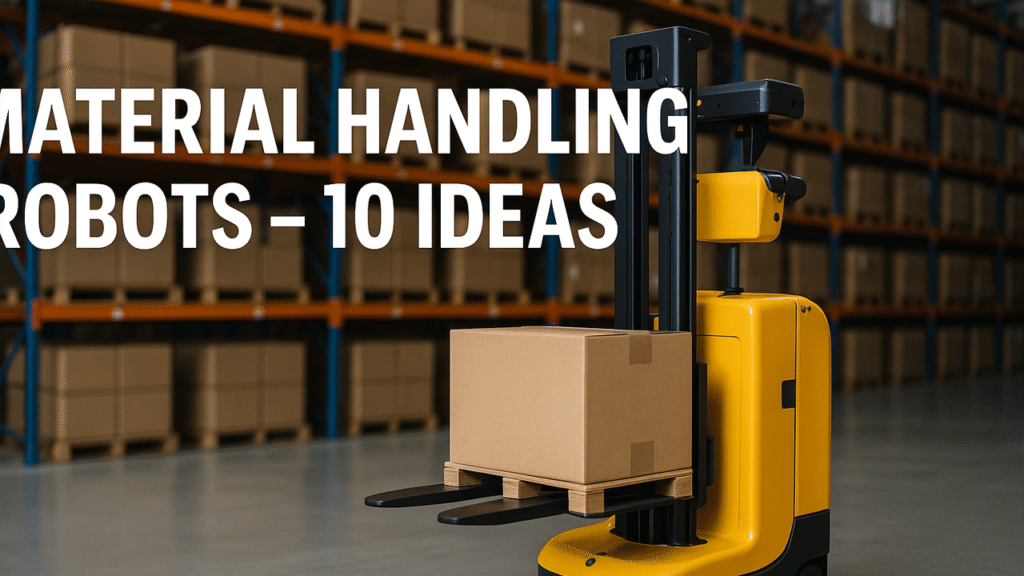
Material Handling Robots – 10 Ideas
How Smart Robotics Are Transforming Movement, Storage, and Efficiency
In today’s fast-paced industrial world, material handling robots are becoming the backbone of modern logistics and manufacturing. From moving pallets to picking delicate items, these robots are reshaping how businesses think about labor, space, and efficiency. Whether you’re a warehouse manager, logistics director, or operations strategist, the potential of robotic material handling is immense — and the opportunity to integrate them strategically has never been greater.
In this article, we’ll explore 10 innovative ideas for material handling robots, why they’re vital to the next era of productivity, and how to get started with the right strategy, support, and talent.
At the end, we’ll show you how Robot Center, Robots of London, and Robot Philosophy can help your business identify, implement, and optimize the right robotics solutions for your operations.
1. Robotic Pallet Movers
One of the most accessible starting points for many businesses, robotic pallet movers (also known as autonomous pallet jacks or AMRs) can navigate warehouses without human supervision. Using lidar, vision sensors, and AI mapping, they transport goods between production lines and storage zones with pinpoint accuracy.
Why it matters:
Replacing manual pallet jacks with robotic ones can reduce injury risks, increase throughput, and free human workers for more skilled tasks.
Example use case:
A food distribution center using robotic pallet movers reduced labor dependency by 30% while maintaining 24/7 operations.
Pro tip: Start small — automate one lane or zone, then scale once efficiency data supports expansion.
2. Automated Guided Vehicles (AGVs)
AGVs are the classic workhorses of industrial automation. They follow pre-defined paths — magnetic tape, QR codes, or laser guidance — to move materials reliably within a structured environment.
Ideal for:
Factories, assembly plants, and environments with repeatable workflows.
Why now:
Modern AGVs have evolved with improved obstacle detection, easier programming, and battery-swap systems that enable continuous operation.
ROI insight:
Even a small fleet of AGVs can deliver a 12–18-month payback through reduced labor and error rates.
3. Autonomous Mobile Robots (AMRs)
While AGVs follow fixed routes, AMRs dynamically navigate spaces in real-time, making them perfect for warehouses and production facilities with variable layouts.
What makes them powerful:
AMRs use simultaneous localization and mapping (SLAM) to learn and adapt. They reroute automatically when obstacles appear, ensuring uninterrupted material flow.
Industries adopting AMRs:
3PL logistics providers
Electronics manufacturers
E-commerce fulfillment centers
Result:
Higher flexibility and scalability — your layout can evolve without costly infrastructure changes.
4. Robotic Arms for Sorting and Picking
When combined with AI vision, robotic arms can now identify, grasp, and sort items of different shapes, colors, and textures. This is a game-changer for facilities dealing with mixed inventory or returns.
Applications:
Sorting products on conveyor belts
Picking items into bins for orders
Removing defects or damaged goods from a line
Future trend:
Cobots (collaborative robots) that work alongside humans to handle fine, repetitive tasks are rapidly gaining traction in logistics and manufacturing sectors.
5. Conveyor-Integrated Robots
While conveyors remain vital for moving goods, combining them with robotic intelligence makes them exponentially more efficient. Vision-equipped robots can detect, scan, and redirect items automatically without stopping the conveyor flow.
Example scenario:
A parcel distribution center uses AI-enabled conveyors to reroute packages in milliseconds based on weight, size, and destination codes.
Impact:
Reduces human error, increases sortation speed, and allows real-time inventory visibility.
6. Mobile Manipulators
Think of mobile manipulators as AMRs with robotic arms mounted on top. They combine movement with dexterity — allowing robots to pick up, carry, and place items in different areas autonomously.
Ideal for:
Warehouses needing flexible material transfer
Hospitals automating supply restocking
Factories performing assembly and inspection
Why it’s exciting:
They represent the next frontier of automation: adaptable, mobile, and multi-skilled robotic workers capable of handling entire workflows.
7. Robotic Forklifts
Traditional forklifts require trained operators and strict safety measures. Robotic forklifts eliminate the need for manual driving while maintaining high payload capacities.
Benefits:
Improved safety through 360° lidar sensors
Consistent handling and stacking accuracy
Real-time fleet monitoring
Use case:
An automotive parts manufacturer replaced 5 manual forklifts with 3 robotic ones and achieved a 25% reduction in floor congestion.
Bonus: They can work lights-out — even in total darkness — reducing energy costs.
8. Collaborative Robots (Cobots) for Material Support
Cobots aren’t just for assembly lines; they can assist with material handling, loading, and packaging. Their lightweight design, safety features, and flexibility make them ideal for small and medium enterprises (SMEs).
Typical applications:
Assisting humans with heavy or repetitive lifting
Handling delicate materials like electronics or glass
Feeding parts into machines or conveyor systems
Why SMEs love them:
Cobots don’t require full cage enclosures, meaning they fit easily into existing spaces — a cost-effective entry point into automation.
9. Overhead Gantry Robots
When floor space is tight, gantry-style robots mounted overhead can automate the vertical movement of goods, bins, or tools. They work seamlessly with conveyors and racking systems.
Applications include:
Large warehouses with multi-tier storage
Automotive manufacturing
Aerospace component handling
Efficiency metric:
Overhead systems can move multiple items simultaneously, improving throughput and reducing travel distances compared to floor-based robots.
10. AI-Powered Inventory Drones and Robotic Shuttles
Combining AI vision, drones, and shuttle robots is one of the latest trends in warehouse automation. These systems handle internal logistics and perform automated stock checks — eliminating manual counting.
Imagine:
A drone flies through aisles scanning barcodes, while an autonomous shuttle below moves items to replenishment zones.
Results:
Real-time inventory accuracy
Reduced human fatigue
24/7 operation without lighting or supervision
This is the future — data-driven, autonomous, and self-learning.
Strategic Integration: Don’t Just Automate — Optimise
Installing robots is one thing. Optimising them for your business goals is another.
At Robot Center, we help businesses identify where robots fit best, optimise workflows, and train teams to manage and maintain the systems long-term.
We believe automation success is not just about technology — it’s about people, processes, and partners working together.
If you’re considering automation, don’t jump straight into a purchase. Start with a robot consultancy audit to find the right opportunities and calculate your ROI properly.
📞 Book a call: sales@robotcenter.co.uk
📱 Call: 0845 528 0404
Our consultants will map out your existing material flow, identify bottlenecks, and recommend the most cost-effective robot solutions for your space.
The Human Side: Recruiting the Right Robotics Talent
Even the best automation projects can struggle without the right people. That’s why Robot Philosophy, powered by RoboPhil, offers a robot recruitment service focused on matching skilled robotics professionals with growing companies.
Whether you need a robotics engineer, integration technician, or AI data specialist — we find the right people who understand both hardware and human collaboration.
With access to a large network of robotics professionals across the UK and Europe, we can help build your internal capability to maintain and expand automation systems effectively.
How to Get Started with Material Handling Robots
Before investing, follow these steps to set your project up for success:
Audit Your Operations – Identify where material handling is slowing production or creating waste.
Assess ROI – Prioritise processes with measurable cost and time savings.
Select the Right Robots – Choose based on payload, distance, environment, and scalability.
Plan Integration – Map out communication between robots, ERP, and WMS systems.
Train Teams – Ensure operators and managers understand safety and maintenance protocols.
Monitor and Optimise – Use analytics to refine performance over time.
Future Trends in Material Handling Robotics
AI-Driven Fleet Coordination – AMRs and AGVs communicating as a swarm for dynamic logistics.
Vision-Based Quality Assurance – Robots identifying defects while handling goods.
Green Robotics – Energy-efficient robots using regenerative braking and solar charging.
Human-Robot Collaboration – Cobots that respond to gestures and voice commands.
Plug-and-Play Robotics – Systems that deploy in days, not months.
These trends are not far away — many are already being deployed across leading facilities worldwide.
Why Work with the Experts
If you’re serious about automating your material handling process, don’t go it alone.
Our team at Robot Center, Robots of London, and Robot Philosophy combines technical expertise, industry experience, and a passion for robotics to guide you every step of the way.
Robot Center – https://robotcenter.co.uk/
Buy Robot, Robot Consultancy, Robotics Solutions, and Implementation.Robots of London – https://robotsoflondon.co.uk/
Robot Hire, Robot Rental, and Event Robotics.Robot Philosophy – https://robophil.com/
Robot Consultancy, Robot Recruitment, Robot Insights, and Robot Advice.
About RoboPhil (Philip English)
Philip English, also known as RoboPhil, is a leading robot YouTuber, consultant, and influencer who’s been helping businesses integrate robotics for over a decade. Through Robot Philosophy, he provides insights, training, and inspiration for the next generation of robotics adopters.
You can watch his videos, attend his workshops, and connect for consulting sessions to explore how robotics can transform your business — practically and profitably.
Final Thoughts
Material handling robots are no longer futuristic — they’re essential. From reducing labor costs to improving efficiency and safety, they form the foundation of the smart factories and warehouses of tomorrow.
Whether you’re exploring automation for the first time or expanding an existing system, the most important step is to start strategically — with data, experience, and the right partners.
That’s where we come in.
📩 Contact us today: sales@robotcenter.co.uk
📞 Book a call: 0845 528 0404
Let’s identify your opportunities, select your robots, and future-proof your operations — together.
Sponsored by:
Robot Center: https://robotcenter.co.uk/ – Buy Robot, Robot Consultancy, Robotics Solutions
Robots of London: https://robotsoflondon.co.uk/ – Robot Hire, Robot Rental, Robot Events
Robot Philosophy: https://robophil.com/ – Robot Consultancy, Robot Recruitment, Robot Insights
https://www.youtube.com/watch?v=kjj083hSRL8