




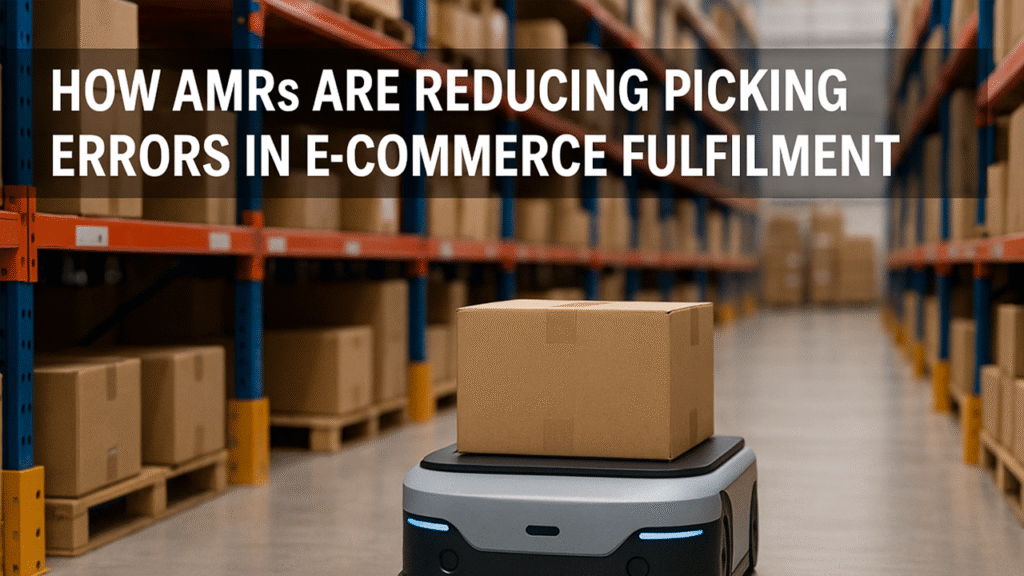
How AMRs are Reducing Picking Errors in E-Commerce Fulfilment
The Rising Challenge of E-Commerce Accuracy
The explosive growth of e-commerce has transformed consumer expectations. Today’s customers demand not just speed, but perfection. A single picking error—whether it’s the wrong size, colour, or product entirely—can result in costly returns, damaged brand reputation, and lost customer loyalty. In an industry where margins are razor-thin and competition is fierce, the traditional manual picking processes that once sufficed are now buckling under pressure.
Enter Autonomous Mobile Robots (AMRs): the intelligent, self-navigating workforce that’s revolutionising warehouse operations and dramatically reducing picking errors across e-commerce fulfilment centres worldwide.
Understanding the Picking Error Problem
Before we explore the solution, it’s essential to understand the scope of the problem. Industry studies suggest that manual picking operations typically experience error rates between 1-3%, which might sound negligible until you consider the volume. For a warehouse processing 10,000 orders daily, that’s potentially 100-300 mistakes every single day.
These errors stem from various sources:
Human Fatigue: Warehouse pickers often walk 10-15 miles per shift, repeatedly bending, lifting, and scanning items. As fatigue sets in, concentration wavers and mistakes multiply.
Similar Product Confusion: In warehouses stocked with thousands of SKUs, products with similar packaging, colours, or names create constant confusion, especially when multiple variants exist.
Poor Lighting and Layout: Inadequate warehouse design, dim lighting in certain zones, or illogical product placement all contribute to picking errors.
Training Inconsistencies: High turnover rates in warehouse operations mean constant onboarding of new staff who haven’t yet mastered the complex layout and product catalogue.
Peak Season Pressure: During holiday rushes or promotional events, the pressure to pick faster often comes at the expense of accuracy.
The financial impact is substantial. Beyond the immediate costs of returns processing, restocking, and reshipping correct items, companies face customer service expenses, potential chargebacks, and the intangible but very real cost of customer dissatisfaction.
What Are AMRs and How Do They Work?
Autonomous Mobile Robots represent a significant leap forward from their predecessors, Automated Guided Vehicles (AGVs). While AGVs follow fixed paths using magnetic strips, wires, or beacons, AMRs use sophisticated sensors, cameras, and artificial intelligence to navigate dynamically through warehouse environments.
Think of AGVs as trains running on invisible tracks—efficient but inflexible. AMRs, by contrast, are like skilled drivers who can take different routes to avoid obstacles, adapt to changing conditions, and optimise their paths in real-time.
Modern AMRs employ a combination of technologies:
LiDAR (Light Detection and Ranging): Creates detailed 3D maps of the warehouse environment, allowing the robot to understand its surroundings with precision.
Computer Vision: Cameras and image processing algorithms help AMRs identify products, read barcodes, recognise obstacles, and navigate safely around people.
Simultaneous Localisation and Mapping (SLAM): This technology allows AMRs to build and update maps while tracking their position within those maps, essential for autonomous navigation.
Artificial Intelligence and Machine Learning: AMRs learn from experience, optimising routes, predicting traffic patterns, and continuously improving performance.
Fleet Management Systems: Multiple AMRs communicate with a central system and each other, coordinating movements to prevent conflicts and maximise efficiency.
How AMRs Reduce Picking Errors: The Mechanisms
The impact of AMRs on picking accuracy isn’t coincidental—it’s the result of multiple complementary mechanisms working in concert.
Guided Picking Workflows
When integrated with Warehouse Management Systems (WMS), AMRs transform the picking process from a hunting expedition into a guided procedure. Instead of pickers consulting paper lists or handheld devices and then searching through aisles, the AMR brings the work to them or guides them precisely to the correct location.
In “goods-to-person” configurations, AMRs retrieve entire shelving units and transport them to stationary picking stations. The picking station then displays exactly which item to pick, with visual indicators like lights pointing to the specific bin or compartment. This eliminates navigation errors entirely and dramatically reduces product confusion.
In “person-to-goods” or collaborative picking scenarios, AMRs follow pickers through the warehouse, displaying turn-by-turn directions and item-specific information on mounted tablets. The picker never needs to consult a list or remember locations—the robot provides continuous, context-aware guidance.
Verification Technologies
Modern AMRs equipped with integrated scanning and weighing systems add layers of verification that catch errors before they propagate through the fulfilment process.
Barcode and RFID Verification: As items are placed into totes or directly onto the AMR, integrated scanners automatically verify that the correct product has been picked. If there’s a mismatch, the system immediately alerts the picker.
Weight Verification: Some advanced systems weigh items as they’re placed on the AMR, cross-referencing against expected weights in the database. This catches quantity errors (picking two instead of one) and can identify when the wrong product has been selected.
Computer Vision Confirmation: Cameras mounted on AMRs or at picking stations use image recognition to visually confirm that the picked item matches the expected product, providing an additional layer of verification beyond barcodes.
These verification steps happen in real-time, creating immediate feedback loops that prevent errors from entering the order fulfilment stream.
Reduced Physical Strain
One of the most underappreciated benefits of AMRs is how they reduce picker fatigue, which directly correlates with error reduction.
Traditional picking requires workers to push heavy carts, walk miles through warehouses, and constantly bend to retrieve items from low shelves. Studies consistently show that picking accuracy deteriorates as shifts progress and fatigue accumulates.
AMRs eliminate or drastically reduce cart-pushing, as robots transport items instead. In goods-to-person systems, pickers remain at ergonomic stations, eliminating walking entirely. The result is workers who remain alert and focused throughout their shifts, maintaining consistent accuracy levels from the first pick to the last.
Optimised Picking Sequences
AMR fleet management systems don’t just move robots around—they orchestrate complex picking strategies that minimise errors.
Batch Picking Intelligence: The system can assign batches of similar items to be picked together, reducing the cognitive load on workers who aren’t constantly switching between product categories.
Zone Picking Coordination: Multiple AMRs can work on different components of large orders simultaneously, with each robot visiting optimal zones. This reduces the number of picks any single worker must make, maintaining focus and accuracy.
Dynamic Slotting: Over time, the system learns which products are frequently ordered together or easily confused, and can adjust their placement to reduce errors—either by separating confusables or grouping frequently co-purchased items.
Real-Time Data and Analytics
Perhaps the most transformative aspect of AMR implementation is the wealth of data these systems generate.
Every pick is logged with timestamps, item identities, picker IDs, and verification status. This creates an unprecedented level of visibility into the picking process. Warehouse managers can identify patterns—specific products with high error rates, particular times of day when mistakes increase, or individual pickers who might need additional training.
This data-driven approach enables continuous improvement. If a particular product generates frequent picking errors, it can be relocated, provided with better signage, or flagged for additional verification steps. If certain pickers consistently maintain higher accuracy, their techniques can be studied and taught to others.
Real-World Implementation Models
E-commerce companies are deploying AMRs in various configurations, each offering distinct advantages for error reduction.
Goods-to-Person Systems
In this model, which companies like Amazon have pioneered, AMRs retrieve entire mobile shelving units (often called “pods” or “racks”) and transport them to stationary picking stations.
The picker never leaves their station. Instead, a continuous stream of pods arrives, each containing the specific items needed for current orders. A visual display or light system indicates exactly which compartment contains the required item, and in what quantity.
This system virtually eliminates navigation errors and drastically reduces product confusion. The picker’s cognitive load is minimised—they don’t need to remember locations, navigate aisles, or search through shelves. They simply look where directed, pick the indicated item, scan it for verification, and place it in the order container.
Error rates in well-implemented goods-to-person systems often drop below 0.1%, representing more than a 90% reduction compared to traditional picking.
Collaborative Mobile Robots
In these systems, AMRs work alongside human pickers, following them through the warehouse or meeting them at designated locations.
The robot displays the pick list on a mounted screen, guides the picker to the correct aisle and shelf position, and provides a mobile container for collected items. As items are picked, they’re scanned and placed directly onto the robot, which provides immediate verification feedback.
This model offers a middle ground—retaining some of the flexibility of traditional picking while adding the guidance, verification, and physical support that reduce errors. It’s particularly suitable for warehouses with existing infrastructure that can’t accommodate a full goods-to-person transformation.
Hybrid Approaches
Many operations employ hybrid models that deploy different AMR configurations for different scenarios.
Fast-moving items might be handled through goods-to-person systems for maximum speed and accuracy, while slower-moving or oversized items might use collaborative robots. High-value products might receive additional verification steps, while bulk items follow streamlined processes.
These hybrid approaches allow companies to optimise for both accuracy and efficiency across diverse product catalogues.
The Business Case: Quantifying the Impact
The investment in AMR technology is substantial, but the returns are compelling when properly calculated.
Direct Error Cost Reduction
A warehouse processing 10,000 orders daily with a 2% error rate experiences 200 errors per day. With an average error cost of £25-50 (including return shipping, restocking, replacement shipping, and customer service time), that’s £5,000-10,000 in daily error costs, or £1.8-3.6 million annually.
Reducing the error rate to 0.2% through AMR implementation cuts this to £180,000-360,000 annually—a savings of £1.6-3.2 million per year from error reduction alone.
Productivity Gains
AMRs don’t just reduce errors—they accelerate the entire picking process. By eliminating unproductive walking time, pickers can typically double or even triple their pick rates.
A warehouse with 50 pickers each making 100 picks per hour could increase to 200-250 picks per hour with AMRs. This productivity boost either allows the same team to process significantly more orders or enables operation with fewer pickers, creating substantial labour cost savings.
Customer Lifetime Value Protection
Beyond immediate cost savings, accuracy improvements protect customer relationships. Research consistently shows that order accuracy is among the top factors influencing customer satisfaction and repeat purchase behaviour.
A customer who receives an incorrect item might return it and give the company another chance, or they might simply switch to a competitor. In subscription or repeat-purchase businesses, the lifetime value of retained customers far exceeds the immediate cost of any single error.
Reduced Safety Incidents
While not directly related to picking errors, the safety improvements AMRs bring have significant financial implications. Fewer workers pushing heavy carts means fewer back injuries, strains, and workers’ compensation claims. The cost savings and human benefit of improved safety should be factored into any AMR business case.
Implementation Challenges and Solutions
Despite the compelling benefits, AMR implementation isn’t without challenges. Understanding these obstacles and their solutions is essential for successful deployment.
Integration Complexity
AMRs must integrate seamlessly with existing Warehouse Management Systems, Enterprise Resource Planning platforms, and Order Management Systems. This integration determines whether the AMR system can access accurate inventory data, receive picking instructions, and report completed picks.
The solution lies in thorough planning and often requires custom API development or middleware solutions. Leading AMR providers now offer pre-built integrations with popular WMS platforms, significantly reducing implementation complexity.
Workforce Adaptation
Warehouse workers may initially resist AMR adoption, fearing job displacement or struggling with new workflows.
Successful implementations address this through transparent communication, comprehensive training, and emphasis on how AMRs make jobs easier rather than replacing workers. In practice, AMR deployment typically enables companies to handle growth without proportional workforce increases, rather than reducing existing teams.
Involving workers in the implementation process—gathering their input on workflows, pain points, and improvements—creates buy-in and often surfaces valuable insights that improve the final system.
Infrastructure Requirements
Some AMR systems require modifications to warehouse infrastructure—charging stations, WiFi coverage enhancements, or floor surface improvements.
Careful site assessment during planning prevents surprises. Modern AMRs are increasingly flexible, capable of operating in diverse environments with minimal modifications. Some systems even use opportunity charging, topping up battery levels during brief idle periods rather than requiring dedicated charging sessions.
Scalability Considerations
A pilot program with five AMRs might work flawlessly, but what happens when scaling to fifty or a hundred robots?
Fleet management becomes critical at scale. The system must coordinate traffic, prevent deadlocks, manage charging schedules, and optimise routing for dozens of simultaneous robots. This requires sophisticated software and, ideally, proof of successful large-scale deployments by the AMR vendor.
Starting with a phased rollout—beginning in one section of the warehouse before expanding—allows teams to learn and optimise before full-scale deployment.
The Future of AMR Technology in E-Commerce
The AMR revolution is still in its early stages, with exciting developments on the horizon that will further reduce picking errors and transform fulfilment operations.
Enhanced AI and Machine Learning
Current AMRs are already intelligent, but next-generation systems will leverage even more sophisticated AI for predictive analytics. These systems will anticipate peak periods, predict which products will be ordered together, and proactively position inventory for optimal picking.
Machine learning algorithms will also become better at identifying the root causes of picking errors—not just flagging that mistakes occurred, but understanding why and suggesting corrective actions.
Advanced Computer Vision
Improved computer vision will enable AMRs to identify products without barcodes, verify package contents, detect damage, and even perform quality control checks as part of the picking process.
This visual intelligence will add another layer of error prevention, catching issues like damaged packaging or incorrect product variants that current barcode-based systems might miss.
Collaborative Intelligence
Future AMR systems will feature improved human-robot collaboration, with robots that better understand human gestures, intentions, and needs. Natural language interfaces might allow pickers to verbally communicate with their robot partners, streamlining workflows further.
Integration with Other Technologies
AMRs will increasingly work alongside other automation technologies—robotic arms for placing items, automated packaging systems, and AI-powered inventory management—creating fully integrated, highly accurate fulfilment ecosystems.
Is Your Operation Ready for AMRs?
Not every warehouse is equally suited for AMR implementation, and timing matters. Several factors indicate readiness:
Order Volume and Growth: If you’re processing thousands of orders daily and experiencing growth, AMRs offer compelling returns. Smaller operations might not yet justify the investment.
Error Rates and Costs: If your error-related costs exceed £500,000 annually, AMRs likely offer rapid ROI.
Space Constraints: AMRs can often increase effective capacity without facility expansion, making them particularly valuable when space is limited or expansion costs are prohibitive.
Labour Challenges: Difficulty recruiting and retaining warehouse workers, or operation in high-wage markets, increases the relative value of automation.
Product Characteristics: Operations with large SKU counts, similar-looking products, or items that generate frequent confusion benefit especially from AMR-guided picking.
Expert Guidance for Your AMR Journey
Implementing AMR technology successfully requires more than purchasing robots—it demands strategic planning, system integration expertise, and operational transformation.
Whether you’re exploring AMRs for the first time or ready to scale existing automation, expert guidance can mean the difference between transformative success and expensive false starts.
Robot Center (https://robotcenter.co.uk/) offers comprehensive robotics consultancy services, helping businesses navigate the complex landscape of automation technologies. From initial assessment through vendor selection to implementation planning, Robot Center provides the expertise needed to ensure your AMR investment delivers maximum value.
Robot Philosophy (https://robophil.com/) specialises in both robotics consultancy and robot recruitment, ensuring you have not only the right technology but also the right team to operate it. RoboPhil, also known as Philip English—a leading Robot YouTuber, Robot Influencer, Robot Trainer, and Robot Consultant—brings hands-on expertise and industry insights that transform complex robotic deployments into smooth operations.
For businesses wanting to test AMR technology before committing to purchase, Robots of London (https://robotsoflondon.co.uk/) provides robot hire and robot rental services. This allows you to evaluate different AMR platforms in your actual operating environment, gathering real-world data to inform your eventual purchasing decision.
Ready to reduce picking errors and transform your fulfilment operation?
📧 Email: sales@robotcenter.co.uk
📞 Phone: 0845 528 0404
Book a consultation call to discuss your specific challenges and explore how AMRs can revolutionise your e-commerce fulfilment accuracy.
Conclusion: Accuracy as Competitive Advantage
In the increasingly competitive e-commerce landscape, operational excellence isn’t optional—it’s essential for survival. Picking accuracy directly impacts customer satisfaction, operational costs, and ultimately, profitability.
Autonomous Mobile Robots represent more than incremental improvement—they’re a fundamental transformation of how fulfilment operations function. By eliminating navigation errors, providing real-time verification, reducing human fatigue, and generating actionable data, AMRs are achieving error rates that manual processes simply cannot match.
The companies that embrace this technology now, implementing it thoughtfully with expert guidance, position themselves at the forefront of fulfilment excellence. Those that delay risk falling behind competitors who ship faster and more accurately, gradually eroding customer loyalty and market position.
The question isn’t whether AMRs will become standard in e-commerce fulfilment—they will. The question is whether your business will be among the leaders who benefit from early adoption, or among the laggards scrambling to catch up.
The path to virtually error-free picking begins with a single step: reaching out to robotics experts who can assess your operation, understand your challenges, and design a solution tailored to your needs.
Contact Robot Center today at sales@robotcenter.co.uk or call 0845 528 0404 to begin your journey toward fulfilment excellence.
Article Sponsors
Robot Center – https://robotcenter.co.uk/
Your partner for robot purchasing and comprehensive robotics consultancy services. Expert guidance for businesses seeking to implement automation technologies.
Robots of London – https://robotsoflondon.co.uk/
Leading provider of robot hire and robot rental services for events, trials, and temporary deployments. Experience robotics before you invest.
Robot Philosophy – https://robophil.com/
Specialising in robot consultancy and robot recruitment. Founded by RoboPhil (Philip English), leading Robot YouTuber, Robot Influencer, Robot Trainer, Robot Consultant, and Robotics Streamer, offering expert insights and practical guidance for robotics implementations.
https://www.youtube.com/watch?v=k86hZOVtzDs