




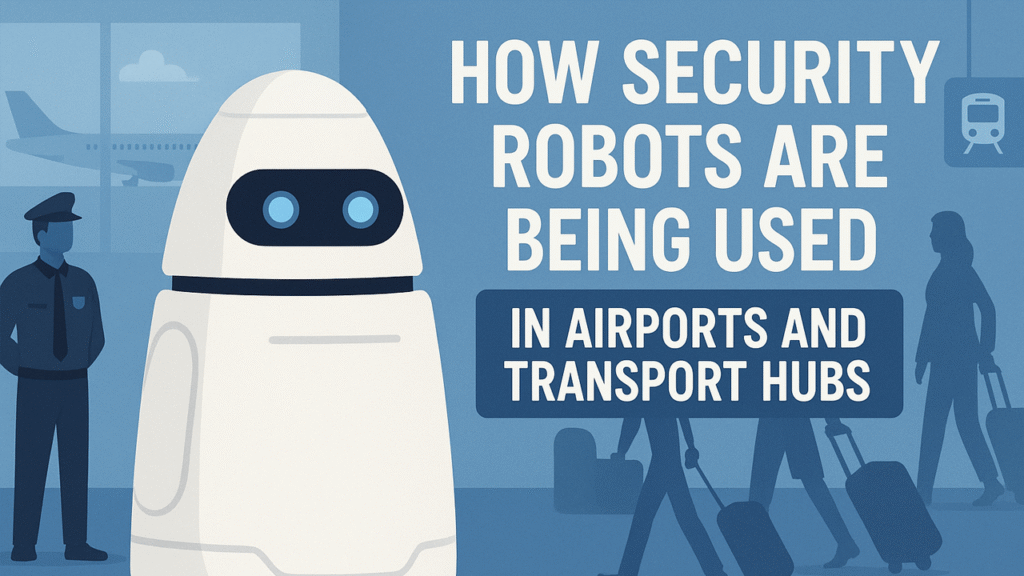
How Security Robots Are Revolutionizing Airports and Transport Hubs: The Future of Automated Security
Sponsored by Robot Center, Robots of London, and Robot Philosophy
The landscape of airport and transport hub security has undergone a dramatic transformation in recent years, with autonomous security robots emerging as game-changing solutions for enhancing safety, efficiency, and passenger experience. As global travel volumes continue to recover and expand, transport authorities are increasingly turning to robotic technology to address complex security challenges while managing operational costs and staffing constraints.
The Evolution of Airport Security Technology
Traditional airport security has long relied on human personnel, static surveillance systems, and manual screening processes. However, the limitations of these conventional approaches have become increasingly apparent in our interconnected world. Long queues, inconsistent security protocols, human error, and the sheer scale of modern transport hubs have created pressing needs for more sophisticated, reliable, and scalable security solutions.
Security robots represent a paradigm shift in how we approach transport hub protection. These sophisticated machines combine artificial intelligence, advanced sensors, mobility platforms, and real-time data processing to create comprehensive security ecosystems that operate 24/7 without fatigue or distraction. Unlike static security cameras or fixed checkpoints, security robots provide dynamic, adaptive monitoring that can respond to changing conditions and emerging threats in real-time.
The integration of robotic security systems in airports and transport hubs isn’t just about replacing human workers—it’s about augmenting human capabilities, creating more efficient processes, and establishing new standards for safety and security that were previously impossible to achieve through traditional methods alone.
Current Applications of Security Robots in Transport Hubs
Perimeter Patrol and Surveillance
Modern security robots excel at perimeter monitoring, utilizing advanced sensor arrays including thermal imaging, high-definition cameras, LIDAR, and radar systems to detect intrusions, suspicious activities, and potential security breaches. These autonomous units can patrol vast areas of airport grounds, including runways, cargo areas, and restricted zones, providing continuous surveillance coverage that would require dozens of human security personnel to match.
The robots’ ability to operate in challenging weather conditions, low-light environments, and hazardous areas makes them particularly valuable for outdoor security applications. They can detect unauthorized personnel, abandoned objects, or unusual activity patterns while simultaneously collecting and analyzing data to identify potential security threats before they escalate.
Passenger Screening and Crowd Monitoring
Inside terminal buildings, security robots are increasingly deployed for passenger flow monitoring, behavioral analysis, and crowd control. These systems use advanced computer vision algorithms to identify suspicious behavior patterns, detect unattended luggage, and monitor passenger density in real-time. The robots can alert security personnel to potential issues while simultaneously gathering data to optimize passenger flow and reduce bottlenecks.
Some advanced security robots are equipped with facial recognition capabilities and can cross-reference passenger information with security databases, helping to identify persons of interest while maintaining compliance with privacy regulations. These systems can also detect prohibited items through advanced scanning technologies, supplementing traditional screening checkpoints.
Emergency Response and Incident Management
Security robots serve as first responders in emergency situations, equipped with communication systems, medical supplies, and emergency protocols. In case of incidents, these robots can quickly navigate to affected areas, assess situations, and provide immediate assistance while human emergency responders are en route. Their ability to operate in potentially dangerous environments, such as areas with chemical spills or structural damage, makes them invaluable for emergency response scenarios.
The robots can also serve as mobile command centers, establishing communication links, coordinating emergency responses, and providing real-time situational awareness to security teams and emergency services. This capability is particularly crucial in large transport hubs where rapid response times can mean the difference between contained incidents and major emergencies.
Key Benefits of Robotic Security Systems
Enhanced Detection Capabilities
Security robots offer superior detection capabilities compared to traditional security systems. Their multi-sensor arrays can simultaneously monitor visual, thermal, acoustic, and electromagnetic spectrums, providing comprehensive situational awareness that human operators cannot match. Machine learning algorithms continuously improve threat detection accuracy, reducing false alarms while increasing sensitivity to genuine security concerns.
The robots’ ability to process vast amounts of data in real-time enables them to identify patterns and anomalies that might be missed by human observers. This enhanced detection capability is particularly valuable in high-traffic environments where security personnel might be overwhelmed by the sheer volume of activity.
Cost-Effective Operations
While the initial investment in robotic security systems can be substantial, the long-term operational costs are significantly lower than maintaining equivalent human security teams. Robots don’t require salaries, benefits, training, or shift scheduling, and they can operate continuously without breaks or time off. This economic advantage becomes particularly pronounced in 24/7 operations like airports and major transport hubs.
The robots also reduce liability risks associated with human security personnel, eliminate issues related to staff turnover and recruitment, and provide consistent performance standards that don’t vary based on individual training or experience levels.
Improved Response Times
Autonomous security robots can respond to incidents within seconds of detection, far faster than human security teams who must first be alerted, then physically travel to incident locations. This rapid response capability is crucial for preventing minor incidents from escalating into major security breaches or safety hazards.
The robots’ mobility and navigation systems allow them to take optimal routes to incident locations, avoiding crowds and obstacles that might delay human responders. Their ability to provide immediate on-scene assessment and begin appropriate response protocols can significantly improve overall security effectiveness.
Data Collection and Analysis
Security robots generate vast amounts of operational data that can be analyzed to improve security protocols, optimize resource allocation, and identify emerging threat patterns. This data-driven approach to security management enables transport hub operators to make informed decisions about security investments, staffing levels, and operational procedures.
The continuous data collection also provides valuable insights into passenger behavior, traffic patterns, and facility utilization that can inform broader operational improvements beyond security considerations.
Challenges and Considerations
Technical Integration Complexity
Implementing robotic security systems in existing transport infrastructure requires careful planning and integration with current security systems, IT networks, and operational procedures. The complexity of modern airports and transport hubs, with their diverse stakeholders, regulatory requirements, and operational constraints, makes system integration a significant challenge requiring specialized expertise.
Successful implementation requires coordination between security teams, IT departments, facilities management, and regulatory authorities to ensure that robotic systems enhance rather than disrupt existing operations. This integration complexity underscores the importance of working with experienced robotics consultants who understand both the technical and operational aspects of transport hub security.
Regulatory and Compliance Issues
The deployment of security robots in transport hubs must comply with numerous regulations covering privacy, data protection, aviation security, and public safety. These regulatory frameworks vary by country and jurisdiction, creating complex compliance requirements that must be carefully navigated during system design and implementation.
Privacy concerns are particularly important, as security robots often collect and process personal data through cameras, sensors, and tracking systems. Ensuring compliance with regulations like GDPR in Europe or similar privacy laws in other jurisdictions requires careful system design and operational procedures.
Public Acceptance and Trust
The introduction of security robots in public spaces raises important questions about public acceptance and trust. Passengers and transport hub users need to feel comfortable with robotic security systems, understanding their capabilities and limitations while feeling confident that their privacy and safety are protected.
Successful deployment requires comprehensive public education, transparent communication about robot capabilities and data usage, and careful attention to user experience design. The robots must be designed to be approachable and non-threatening while maintaining their security effectiveness.
Future Trends and Developments
Artificial Intelligence Advancement
The future of security robots lies in increasingly sophisticated AI capabilities. Advanced machine learning algorithms will enable robots to better understand context, predict potential security threats, and make more nuanced decisions about response protocols. Natural language processing will allow robots to interact more effectively with passengers and security personnel, while computer vision improvements will enhance threat detection accuracy.
These AI advancements will also enable robots to learn from experience, continuously improving their performance and adapting to changing security environments. The integration of AI with cloud computing will allow security robots to share intelligence and learn from incidents across multiple locations.
Swarm Intelligence and Coordination
Future security robot deployments will likely involve coordinated swarms of robots working together to provide comprehensive security coverage. These systems will use distributed intelligence to optimize patrol routes, coordinate responses to incidents, and maintain situational awareness across large areas.
Swarm robotics will enable more flexible and adaptive security systems that can respond to changing conditions by redistributing resources and capabilities as needed. This approach will be particularly valuable in large transport hubs where security needs vary by time of day, passenger volume, and operational conditions.
Enhanced Mobility and Autonomy
Advances in robotics technology will produce more capable and autonomous security robots with improved mobility, longer operational endurance, and enhanced sensor capabilities. These improvements will enable robots to operate in more challenging environments and provide more comprehensive security coverage.
Future security robots may include aerial drones for overhead surveillance, underwater robots for maritime transport security, and specialized robots designed for specific security tasks like explosive detection or chemical sensing.
Case Studies: Successful Implementations
Singapore Changi Airport
Singapore Changi Airport has been a pioneer in deploying security robots, implementing autonomous patrol robots that monitor terminal areas, detect suspicious activities, and provide passenger assistance. The robots have successfully reduced security incidents while improving passenger satisfaction through their helpful, approachable design.
The implementation at Changi demonstrates the importance of comprehensive planning, staff training, and public education in successful robot deployment. The airport’s experience provides valuable insights for other transport hubs considering similar implementations.
Dubai International Airport
Dubai International Airport has integrated security robots with advanced AI capabilities for passenger screening and behavior analysis. The robots work alongside human security personnel to enhance detection capabilities while maintaining efficient passenger flow through security checkpoints.
The Dubai implementation showcases how security robots can be integrated with existing security infrastructure to create more effective and efficient security systems without completely replacing human personnel.
London Heathrow Airport
London Heathrow has deployed security robots for perimeter monitoring and cargo area surveillance, demonstrating the robots’ effectiveness in challenging outdoor environments. The robots’ ability to operate in various weather conditions while maintaining high detection accuracy has proven valuable for securing large airport perimeters.
The Heathrow experience highlights the importance of robust, weather-resistant robot designs and the value of continuous monitoring capabilities in maintaining airport security.
Implementation Best Practices
Comprehensive Needs Assessment
Successful security robot implementation begins with a thorough assessment of current security needs, challenges, and objectives. This assessment should consider existing security infrastructure, staffing levels, regulatory requirements, and operational constraints to identify the most appropriate robotic solutions.
The needs assessment should also consider future growth plans, changing security threats, and evolving regulatory requirements to ensure that robotic systems remain effective and compliant over time.
Stakeholder Engagement
Effective implementation requires engagement with all relevant stakeholders, including security personnel, operations staff, regulatory authorities, and passengers. This engagement ensures that robotic systems are designed to meet real operational needs while addressing concerns and building support for the technology.
Stakeholder engagement should begin early in the planning process and continue throughout implementation and operation to ensure ongoing success and acceptance.
Phased Implementation Strategy
Most successful security robot deployments use phased implementation strategies that allow for gradual integration, testing, and refinement. This approach reduces risk, allows for learning and adaptation, and helps build confidence in the technology among staff and passengers.
Phased implementation also allows for budget management and provides opportunities to demonstrate value before making larger investments in expanded robot deployments.
Training and Change Management
Implementing security robots requires comprehensive training for security personnel, operations staff, and other stakeholders who will work with or around the robots. This training should cover robot capabilities, limitations, operational procedures, and emergency protocols.
Change management programs help staff adapt to new technologies and processes, ensuring that human and robotic systems work together effectively to achieve security objectives.
The Business Case for Security Robots
Return on Investment Analysis
The business case for security robots is compelling when considering the total cost of ownership over their operational lifetime. While initial capital investments can be substantial, the ongoing operational savings from reduced staffing requirements, improved efficiency, and enhanced security effectiveness typically provide strong returns on investment.
ROI calculations should consider direct cost savings, risk reduction benefits, operational efficiency improvements, and strategic advantages that security robots provide compared to traditional security approaches.
Risk Mitigation Value
Security robots provide significant risk mitigation value by reducing human error, improving response times, and providing consistent, reliable security coverage. These risk reduction benefits can be quantified in terms of reduced incident rates, lower insurance costs, and avoided losses from security breaches.
The 24/7 operational capability of security robots provides risk mitigation value that is difficult to achieve with human-only security systems, particularly in large transport hubs with complex security requirements.
Operational Efficiency Gains
Beyond direct security benefits, security robots often provide operational efficiency gains through improved data collection, better resource allocation, and enhanced coordination with other systems. These efficiency improvements can reduce overall operational costs while improving passenger experience and facility utilization.
The data collected by security robots can also provide valuable insights for optimizing other aspects of transport hub operations, creating additional value beyond security applications.
Selecting the Right Security Robot Solution
Technical Requirements Assessment
Selecting appropriate security robot solutions requires careful assessment of technical requirements including sensor capabilities, mobility requirements, communication systems, and integration needs. The chosen solution must match the specific security challenges and operational environment of the transport hub.
Technical requirements should also consider future needs and expansion plans to ensure that robotic systems can adapt and grow with changing requirements.
Vendor Evaluation Criteria
Evaluating security robot vendors requires consideration of multiple factors including technical capabilities, implementation experience, ongoing support, and financial stability. The chosen vendor should have demonstrated experience in transport hub security applications and the ability to provide comprehensive support throughout the system lifecycle.
Vendor evaluation should also consider the vendor’s ability to integrate with existing systems, provide training and support, and adapt to changing requirements over time.
Total Cost of Ownership
Understanding the total cost of ownership for security robot systems requires consideration of initial capital costs, ongoing operational expenses, maintenance requirements, and upgrade costs. This comprehensive cost analysis helps ensure that the chosen solution provides value throughout its operational lifetime.
Total cost of ownership analysis should also consider the opportunity costs of alternative security approaches and the value of enhanced security capabilities and risk mitigation.
Professional Services and Support
Robotics Consultancy Services
The complexity of implementing security robots in transport hubs requires specialized expertise in robotics technology, security systems, and operational integration. Professional robotics consultancy services can help transport hub operators navigate the technical, operational, and regulatory challenges of robot deployment.
Experienced consultants can provide valuable guidance on system selection, implementation planning, regulatory compliance, and operational optimization to ensure successful robot deployments.
System Integration Support
Integrating security robots with existing transport hub systems requires specialized technical expertise and project management capabilities. Professional system integration services can help ensure that robotic systems work seamlessly with current security infrastructure, IT networks, and operational procedures.
System integration support should include technical design, installation oversight, testing and commissioning, and ongoing optimization to ensure optimal system performance.
Training and Support Services
Successful security robot deployment requires comprehensive training for staff and ongoing support for system operation and maintenance. Professional training services can help ensure that personnel are prepared to work effectively with robotic systems and can respond appropriately to various operational scenarios.
Ongoing support services help maintain system performance, address technical issues, and provide updates and improvements as technology evolves and operational needs change.
Conclusion: The Future of Transport Security
Security robots represent a transformative technology that is reshaping how we approach safety and security in airports and transport hubs. As these systems continue to evolve and mature, they will become increasingly sophisticated, capable, and integral to transport security operations.
The successful implementation of security robots requires careful planning, specialized expertise, and comprehensive support throughout the deployment process. Transport hub operators who invest in robotic security systems today will be well-positioned to meet the evolving security challenges of tomorrow while providing enhanced safety and efficiency for passengers and operations.
The future of transport security will be characterized by seamless integration of human expertise and robotic capabilities, creating security systems that are more effective, efficient, and adaptable than either approach could achieve alone. As this technology continues to advance, the opportunities for enhancing transport hub security through robotics will only continue to grow.
For transport hub operators considering security robot deployment, the key to success lies in working with experienced partners who can provide comprehensive guidance, support, and expertise throughout the implementation process. With the right approach and support, security robots can transform transport hub security while providing significant operational and economic benefits.
About Our Sponsors
Robot Center – Your premier destination for comprehensive robotics solutions. Whether you’re looking to buy robots, seeking expert robotics consultancy, or need specialized guidance for your automation projects, Robot Center provides end-to-end support for all your robotic needs. Visit robotcenter.co.uk to explore our extensive range of robotic solutions and consultancy services.
Robots of London – London’s leading robot hire and rental specialist. From corporate events to temporary deployments, Robots of London provides flexible robot rental solutions to meet your specific needs. Our comprehensive robot hire service ensures you have access to the latest robotic technology without the long-term investment. Discover more at robotsoflondon.co.uk.
Robot Philosophy – Your strategic partner for robotics consultancy and recruitment. Combining deep technical expertise with strategic insights, Robot Philosophy helps organizations navigate the complex landscape of robotic technology adoption. From initial consultation to ongoing support, we provide the advice, insights, and recruitment services you need to succeed with robotics. Learn more at robophil.com.
Ready to Transform Your Security Operations?
The implementation of security robots in your transport hub or airport requires specialized expertise and strategic planning. Our team of robotics consultants can help you navigate the complex process of selecting, implementing, and optimizing robotic security solutions for your specific needs.
Contact us today to discuss your security robot requirements:
📧 Email: sales@robotcenter.co.uk
📞 Phone: 0845 528 0404
Don’t let outdated security systems hold your operations back. Book a consultation call today to discover how security robots can transform your transport hub security while reducing costs and improving operational efficiency. Our experienced team is ready to help you take the next step toward the future of automated security.