




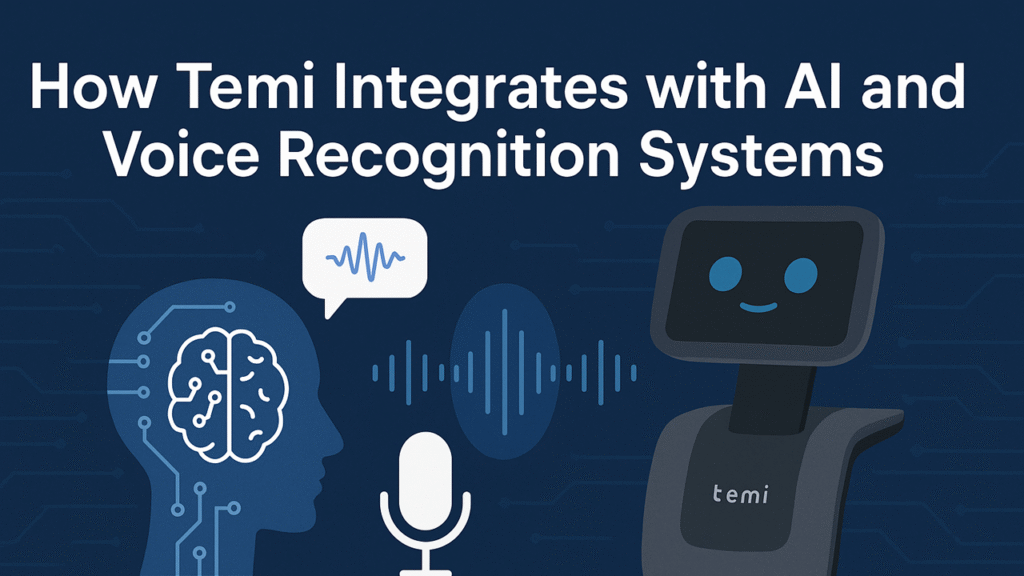
How temi Integrates with AI and Voice Recognition Systems
Sponsored by
Robot Center (https://robotcenter.co.uk/) — Buy Robot, Robot Buy, Robot Consultancy, Robotics Consultancy
Robots of London (https://robotsoflondon.co.uk/) — Robot Hire, Robot Rental, Rent Robot, Hire Robot, Robot Events
Robot Philosophy (https://robophil.com/) — Robot Consultancy AND Robot Recruitment, Robot Advice, Robot Insights, Robot Ideas. (RoboPhil, also known as Philip English, is a leading Robot YouTuber, Robot Influencer, Robot Trainer, Robot Consultant and Robotics Streamer)
If you’re exploring how the next generation of service robots can integrate with AI and voice systems — and what that means for your business — this article will deep-dive into the capabilities of the temi robot, how it accomplishes voice recognition and AI integration, and how your organisation can unlock its full potential with expert consulting and recruitment support.
Introduction
In the evolving world of robotics, the fusion of mobility, voice interaction and artificial intelligence is redefining how robots operate in commercial environments. The temi robot (by the brand temi) stands at the intersection of autonomous navigation, conversational AI and enterprise-grade deployment. This makes it a compelling platform for businesses looking to embed robotics into their operations — but also raises complexity that many organisations are unprepared for.
That’s where professional consultancy and recruitment become critical. If you’re deploying temi or similar robots and want to maximise value while avoiding pitfalls, engaging the right partners is key. This is precisely the sweet spot for Robot Center (robot buy and consultancy), Robots of London (robot hire, rental, events) and Robot Philosophy (robot consultancy and recruitment).
In this article we’ll cover:
The temi platform architecture: sensors, mobility, cloud, AI & voice.
How voice recognition is implemented in the robot.
How AI (especially conversational and behavioural AI) is layered on temi.
Integration scenarios in enterprise and service contexts.
Challenges and best practices for deployment.
How expert consulting and specialist recruitment can support you.
A call to action for your business.
1. temi Platform Architecture: Mobility, Sensors & Cloud
Before diving into AI and voice, it’s useful to understand the physical and software architecture of the temi robot — because every integration decision builds on the robot’s foundational capabilities.
Physical & sensor architecture
temi includes 360° LiDAR, depth / RGB cameras, time-of-flight sensors, IMU and other sensing modalities for mapping, localisation, obstacle avoidance and human tracking. Robotics for Good+1
The mobility design allows temi to autonomously navigate indoor spaces (offices, hotels, healthcare, retail) with user-tracking and “follow” behaviours. 邁克兄弟科技股份有限公司+1
The hardware runs on an Android-based OS (temi OS) and integrates cloud connectivity for monitoring, fleet management and remote control. iPresence –
Software/Cloud architecture
A management system (“temi centre” or equivalent) allows remote configuration of routes, saved locations, user permissions and monitoring of robot status. iPresence –
Developers can access an SDK (Software Development Kit) to build custom applications on temi — giving it extensibility beyond its base features. Robotics for Good+1
Why this matters
Having a robust sensor/mobility foundation and cloud/SDK architecture means temi can serve as more than just a video-call robot. It becomes a platform for voice-AI, conversational interfaces, guidance and service automation. But it also means rollout requires attention to network, mapping, configuration, user-flow and integration with existing systems. That’s where consultancy comes in.
2. Voice Recognition & Natural Language Interface
One of the key differentiators of a modern service robot is its ability to interact via voice, and temi delivers on this front. Here’s how.
Wake-word & far-field voice capture
temi supports far-field voice recognition (microphone array, beam-forming, echo cancellation) so that users can issue voice commands from a distance. Robotics for Good+1
It supports custom wake-words (“Hey temi”) or integration with Alexa, enabling voice-initiated flows. 邁克兄弟科技股份有限公司
Automatic Speech Recognition (ASR), Natural Language Processing (NLP), Text-to-Speech (TTS)
On the temi platform you will find an ASR engine converting spoken phrases into text, an NLP layer to interpret intent, and a TTS engine to respond verbally. Robotics for Good+1
For enterprise use-cases, the NLP may be customised (via SDK) to recognise domain-specific commands (“take me to meeting room A”, “show me the coffee station”, etc.).
Integration with voice assistants / smart systems
temi integrates with Alexa and can also embed its own “Hey temi” voice assistant. Example: you could say, “Alexa, tell my temi to go to the reception desk” or “Hey temi, call John” once configured. 邁克兄弟科技股份有限公司+1
This voice interface opens up possibilities: navigation by voice, dynamic content display on the screen, voice-initiated video calls, voice-driven tours, and voice control of connected devices through temi.
Why this matters for a business
For any organisation using robots for customer service, hospitality, healthcare or events, voice is the most natural interface for many users. temi’s voice recognition lets you:
Remove the barrier of “pressing buttons” or “going to a terminal”.
Offer a conversational experience: users speak, temi responds, navigates or performs tasks.
Integrate voice flows into service automation workflows (e.g., visitor says “I have an appointment with Jane”, temi triggers meeting room guidance and notifies Jane).
However, voice implementation is not plug-and-play. It requires: training the voice model for accent/locale; defining intents and utterances; mapping voice commands to robot actions; handling fallback behaviour; securing the system; ensuring network latency is acceptable; configuring the wake-word and microphone environment. These are areas where specialist consultancy helps.
3. AI Integration: Conversational, Predictive & Behavioural
Beyond simple voice commands, temi becomes powerful when layered with AI — especially conversational AI, large-language-model (LLM) support, predictive analytics and behavioural responses.
Conversational AI / LLM integration
The temi architecture supports integration with cloud-based AI services (for example LLM backend) to allow the robot to hold more natural, context-rich conversations, not just execute commands. AI Hub+1
For instance, a user might ask: “Hey temi, what’s on the agenda today?”, or “temi, can you walk me through the safety procedure for this zone?”— and the robot interprets, accesses enterprise backend, responds via voice and displays relevant content.
In a study at the Centre for Applied AI, temi was integrated with a custom LLM to handle patient requests in a healthcare setting: speech → NLP → reasoning → action (alert nurse) without additional input. AI Hub
Predictive and behavioural AI
temi’s sensor and navigation capabilities produce rich data: user interactions, movement patterns, location visits, dwell times. AI models can analyse this to predict user needs — for example guiding a visitor proactively before they ask, or optimising cleaning and maintenance schedules in a facility.
Behavioural AI can personalise interactions: recognising a returning user, greeting them by name, knowing their preferred route, offering suggestions. temi’s facial recognition and user-tracking are enablers. Robotics for Good
Integration with enterprise systems
For full benefit, temi’s AI must tie into enterprise databases, scheduling systems, CRMs, building-management systems or IoT platforms. For example: visitor schedule → temi greeting → robot escort to meeting room → notify host via Slack/Teams.
The SDK and cloud components provide the hooks; the business logic, AI workflows and integration architecture typically require consultancy support and skilled robotics/AI engineers.
Why this matters
In a world where robots are increasingly expected to do more than just “navigate and talk”, the AI layer becomes the differentiator: turn a robot into a service-agent, concierge, guide, or even sales assistant. That creates measurable business value: improved visitor experience, reduced manpower cost, 24/7 presence, data insights. But the complexity is non-trivial—successful AI integration demands clear use-cases, data pipelines, voice and sensor workflows, and change-management.
4. Integration Scenarios: Real-World Use Cases
Here are several scenarios showing how temi’s voice & AI integration plays out in real business environments — illustrating why you might want to bring in professional consultancy and recruitment to deliver the solution.
Hospitality / Events
A hotel deploys temi at reception: guests speak with temi (“I have a reservation under Smith”), temi checks the booking system via API, greets guest, escorts them to the lobby lounge or elevator, asks if they’d like room service via voice, and optionally alerts staff for special requests. The voice interface and autonomous navigation make it intuitively human-facing.
Healthcare / Social Care
In a care home, temi patrols corridors, recognizes residents via facial recognition, asks “Good morning, Mrs Johnson – would you like your breakfast now?”, and if the resident says they’ve fallen or are unwell, temi uses AI logic to alert staff. The voice recognition enables hands-free interaction, AI enables symptom detection and decision support. AI Hub
Corporate office / Reception & Visitor Guidance
In a large corporate office, temi acts as a greeter: “Welcome, please say your name” → voice recognition + booking system lookup → temi guides visitor to meeting room, offers refreshments. Voice commands (“temi, open door for me”) link to access systems. The data gathered (visitor counts, routes, dwell times) feeds into analytics for space utilisation.
Retail / Showroom
Temi is placed in a showroom: voice prompts like “Hey temi, show me the red model” trigger display, navigation, product catalogue presentation. Advanced AI can also answer product questions, compare features, upsell accessories. Customers can interact naturally via voice rather than touchscreen.
Rental / Event Robotics
Through a hire model (e.g., via Robots of London), companies bring temi into exhibitions, trade shows or events. temi’s voice and AI interface engages attendees (“Welcome to our booth, would you like a demonstration?”), collects visitor leads, sends data to CRM, and autonomously returns to charging station when idle. The robotics consultancy partner manages setup, mapping, voice flows, branding UI overlay.
These use-cases illustrate how temi, voice and AI converge. The value is compelling—but the deployment complexity is non-trivial.
5. Challenges & Best Practices for Deployment
While the benefits are clear, organisations often stumble when implementing robotic platforms like temi with voice and AI integration. Here are common pitfalls and recommended best practices.
Challenges
Network connectivity & security: temi’s cloud and voice features require reliable WiFi, proper firewall configuration, and may require ports to be open or whitelisted. Failures here lead to robot downtime. iPresence –
Voice recognition variability: accents, background noise, far-field audio issues can degrade ASR performance. Without proper tuning, voice commands may fail, frustrating users.
User-flow and interface design: Voice + navigation + UI need to be designed together. A mismatch (e.g., voice says “follow me” but robot doesn’t recognise user) creates poor experience.
Integration complexity: connecting temi to backend systems (CRM, booking systems, building management, IoT) requires middleware, APIs, security considerations.
Mapping and mobility issues: Robot needs accurate map of environment; changes in environment (new furniture, open doors) may require remapping or adjustments.
ROI clarity: Without defined KPIs (visitor greet rate, cost reduction, lead capture, dwell time), it’s hard to justify investment.
Skilled resources: Running such a deployment often requires robotics engineers, voice/NLP specialists, UX designers. Many organisations don’t have those in house.
Best Practices
Start with clear use-case and KPIs: Define exactly what temi will do, how voice interface contributes, and how AI adds value.
Pilot in a controlled zone: Map a portion of the site, test voice command set, monitor user interaction, tune ASR/NLP.
Design voice workflows from the user’s perspective: What do visitors want? What natural language will they use? Define intents and handle fallback gracefully.
Design for network & infrastructure: Ensure WiFi coverage, firewall exceptions, remote monitoring dashboard, robot charging stations.
Leverage SDK and AI partners: Customisation is key—SDK enables tailoring; AI integration may require external specialist or consultancy.
Train staff & define escalation workflows: Robot answers 80 % of queries, but define what happens for the remaining 20 % (hand over to human).
Plan for uptime and maintenance: Robotics hardware needs servicing, software updates, sensor recalibration.
Measure outcomes: Track metrics (engagement rate, repeat usage, visitor satisfaction, cost savings, lead conversions) and iterate.
6. Why You Should Engage Expert Consulting & Recruitment
Given the technical, operational and organisational challenges, deploying a temi robot effectively is not simply a matter of buying the hardware. That’s where professional support from consultancy and specialist recruitment adds real value. Here’s how our services help:
Consulting Services
Through Robot Center (robot buy and robotics consultancy) we help you select the right robot (temi or alternative), define the use-case, build the business case, and manage the purchase.
Through Robot Philosophy (robot consultancy and recruitment) we help you design the integration architecture: voice/NLP workflows, AI stack, system integration, user experience design.
Through Robots of London (robot hire, rental, events) we can supply temi on a hire or rental basis for pilot deployment, events or temporary use, with turnkey setup and mapping.
Recruitment Services
Your successful deployment of temi may require hiring robotics engineers, voice/NLP specialists, UX designers or robot operator staff. Robot Philosophy offers recruitment services specialising in the robotics domain — letting you plug in the right talent without going through lengthy hiring processes.
Having the right people from the start ensures your voice/AI deployment doesn’t stall due to lack of resource or expertise.
Why this combination matters
Purchasing a temi robot is only the start. To extract business value you need strategy → integration → deployment → measurement → iteration. Without consultation you risk wasted hardware, frustrated users and missed ROI. Without the right talent you risk never realising the voice/AI promise. By leveraging consultancy + recruitment you accelerate time-to-value, de-risk your investment and ensure scalability.
7. How to Get Started
If you’re ready to explore how temi and voice/AI integration can transform your business — here’s a simple roadmap and how to take the next step.
Step 1: Discovery Call
Contact our team to discuss your environment, goals and constraints. We’ll run a short audit (remote or on-site) to map the use-case, stakeholders, visitor flows and readiness.
Step 2: Pilot & Proof-of-Concept
Deploy temi in a contained zone (e.g., reception area) with voice commands, basic navigation and AI/voice workflows. Measure KPIs, collect user feedback and iterate.
Step 3: Full Deployment & Scale-Out
Roll out to multiple zones or sites, integrate with backend systems (CRM, scheduling, smart building), refine voice/NLP, train staff, set up monitoring.
Step 4: Optimise & Expand
Use data from temi (visitor counts, dwell times, voice interactions, follow mode) to derive insights, refine AI workflows, improve visitor experience and unlock new value streams (e.g., upsell, guided tours, event engagement).
To book in a discovery call or audit, reach out to us at:
📧 sales@robotcenter.co.uk
📞 0845 528 0404
Let us help you turn robotics into measurable business advantage.
Summary
The temi robot is a compelling platform that brings together mobility, voice recognition and AI integration — enabling use-cases from hospitality to healthcare, retail to events. But the technology alone isn’t enough: the value lies in how you define the use-case, design the voice workflows, integrate AI and back-end systems, manage infrastructure and recruit the right talent.
That’s exactly where our combined services from Robot Center, Robots of London and Robot Philosophy come in. If you’re serious about deploying temi (or similar service robots) and want to ensure success from day one, let’s talk.
📧 sales@robotcenter.co.uk
📞 0845 528 0404
https://www.youtube.com/watch?v=p3V3iUmzLrU
https://www.youtube.com/shorts/ZGf6I-0JcAI
Temi
Temi