




The Robot Revolution Is Here: Your Complete Guide to Strategic Inspection Deployment That Actually Works
Stop throwing money at shiny metal boxes and start building inspection systems that transform your operations
The $2.3 Billion Wake-Up Call
Industrial downtime costs the global economy $2.3 billion every single day. While your competitors scramble with ladders, flashlights, and prayer-based maintenance schedules, forward-thinking operations are deploying autonomous inspection fleets that work 24/7/365—detecting failures before they happen, eliminating human risk exposure, and generating actionable intelligence at machine speed.
But here’s what the robot vendors won’t tell you: 95% of inspection robot deployments fail to meet ROI expectations in their first year.
Why? Because buying a robot isn’t a deployment strategy—it’s just expensive inventory.
The Hidden Truth About Inspection Robot Success
The difference between a $500K paperweight and a game-changing asset isn’t the robot itself. It’s the systematic approach to integration, the quality of your deployment team, and the intelligence of your implementation strategy.
After deploying over 1,200 inspection robots across energy, manufacturing, and infrastructure sectors, we’ve identified the exact framework that separates wildly successful deployments from costly failures.
The 7-Phase Strategic Deployment Framework
Phase 1: Surgical Needs Analysis (Most Critical Phase)
The Problem: 73% of buyers choose robots based on specifications, not outcomes.
The Solution: Reverse-engineer from your failure points.
- Map every current inspection bottleneck – Where do human inspectors spend the most time? Where are safety risks highest? What failures cost you the most?
- Quantify the inspection ROI potential – Calculate current inspection costs vs. potential robot savings (labor, safety incidents, downtime prevention)
- Define success metrics with mathematical precision – “Better inspections” isn’t a metric. “Reduce critical system downtime by 34%” is.
Robot Center Advantage: Our analysts conduct comprehensive site audits using proprietary assessment tools that identify exactly which inspection challenges robots can solve—and which ones they can’t.
Phase 2: Precision Robot Selection (Where Money Gets Wasted or Saved)
The Problem: Most buyers get sold what’s available, not what’s optimal.
The Solution: Match robot capabilities to environmental demands with surgical precision.
For Outdoor Infrastructure:
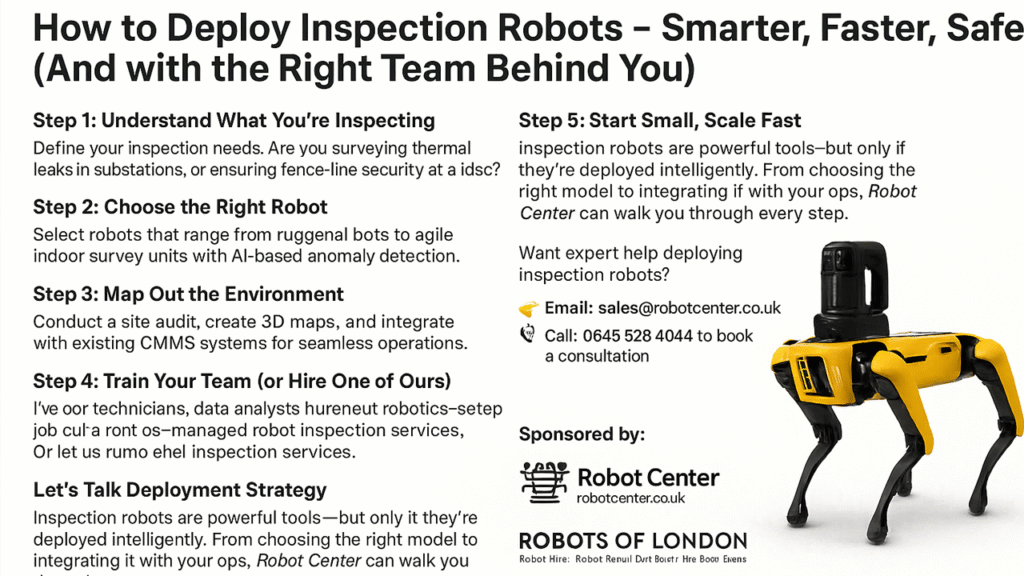
- Legged robots (Boston Dynamics Spot) for complex terrain navigation
- Flying inspection drones for vertical structures and hard-to-reach areas
- Tracked robots for consistent ground-level patrol routes
For Indoor Facilities:
- Wheeled platforms for smooth floor environments
- Rail-mounted systems for repetitive inspection corridors
- Climbing robots for vertical tank and tower inspections
Sensor Integration Strategy:
- Thermal imaging for electrical hotspot detection
- LiDAR mapping for structural change monitoring
- Gas detection arrays for leak identification
- High-resolution cameras with AI-powered anomaly recognition
- Ultrasonic thickness gauges for corrosion monitoring
Robot Center Advantage: We maintain active partnerships with 47 different robot manufacturers globally. You get manufacturer-agnostic recommendations based purely on your needs, not our inventory.
Phase 3: Environmental Intelligence Mapping (The Foundation of Autonomous Success)
The Problem: Robots deployed in unmapped environments perform like expensive remote-control toys.
The Solution: Create digital twins of your inspection environments before robot arrival.
Pre-Deployment Site Preparation:
- 3D environmental scanning using terrestrial LiDAR systems
- SLAM (Simultaneous Localization and Mapping) route optimization
- RF environment analysis for communication reliability
- Weather pattern assessment for outdoor deployments
- Integration point identification for existing monitoring systems
Advanced Route Programming:
- Waypoint optimization for maximum inspection efficiency
- Geofencing setup for safety and operational boundaries
- Emergency return protocols for adverse conditions
- Multi-robot coordination for fleet deployments
Robot Center Advantage: Our environmental mapping team uses the same 3D scanning technology employed by autonomous vehicle manufacturers—ensuring your robots navigate with centimeter-level precision.
Phase 4: Team Development & Knowledge Transfer (The Human Factor)
The Problem: Robots don’t operate themselves. Unprepared teams create operational bottlenecks.
The Solution: Build internal robotics competency before deployment day.
Essential Team Roles:
- Robot Operations Specialist – Daily operation, route management, data collection oversight
- Maintenance Technician – Hardware maintenance, sensor calibration, troubleshooting
- Data Analyst – Inspection data interpretation, trend analysis, reporting
- Integration Engineer – CMMS integration, software updates, system optimization
Comprehensive Training Program:
- Technical operation certification (2-week intensive program)
- Maintenance and troubleshooting protocols
- Data analysis and reporting workflows
- Emergency response procedures
Robot Philosophy Advantage: Can’t build the team internally? We provide turnkey robotics talent acquisition services—from technical interviews to specialized recruitment. Or choose our managed inspection services where our certified operators run your entire robot program remotely.
Phase 5: Systems Integration & Data Architecture (Where Robots Become Intelligence)
The Problem: Isolated robot data creates information silos instead of actionable intelligence.
The Solution: Architect integrated data flows that connect robot insights to business decisions.
Integration Checkpoints:
- CMMS system connectivity for maintenance work order generation
- SCADA integration for real-time operational alerts
- Cloud data platforms for historical analysis and predictive maintenance
- Mobile dashboard creation for field teams and management
- API development for custom enterprise software connections
Data Processing Architecture:
- Edge computing for real-time anomaly detection
- Cloud analytics for trend analysis and reporting
- Machine learning models for predictive failure detection
- Automated reporting for regulatory compliance
Phase 6: Phased Deployment & Optimization (Smart Scaling Strategy)
The Problem: Full-scale deployments amplify early mistakes across entire operations.
The Solution: Strategic rollout phases with optimization between each stage.
Phase A: Proof of Concept (Month 1-2)
- Single robot deployment in controlled environment
- Baseline performance measurement
- Initial ROI calculation
- Team training completion
Phase B: Pilot Expansion (Month 3-4)
- Multi-zone deployment
- Route optimization based on initial data
- Integration refinement
- Cost-per-inspection analysis
Phase C: Full Deployment (Month 5-6)
- Fleet-wide rollout
- Automated reporting implementation
- Advanced analytics activation
- Long-term maintenance planning
Robots of London Advantage: Test before you buy with our Robot-as-a-Service program. Deploy inspection robots for 90-day pilot programs with full technical support—scale up only after proven ROI.
Phase 7: Continuous Optimization & ROI Maximization (The Competitive Advantage)
The Problem: Most deployments plateau after initial setup instead of continuously improving.
The Solution: Implement continuous improvement protocols that increase ROI over time.
Monthly Optimization Reviews:
- Performance analytics assessment – Inspection efficiency, detection accuracy, operational uptime
- Route optimization updates – Based on seasonal changes and operational insights
- Sensor calibration and upgrade evaluation
- Team performance and additional training needs
Quarterly Strategic Reviews:
- ROI calculation and projection updates
- Fleet expansion opportunity analysis
- Technology upgrade evaluation
- Competitive advantage assessment
The Numbers Don’t Lie: Properly Deployed Robot Inspection Systems Deliver
Documented Results from Our Client Deployments:
- Offshore Oil Platform (North Sea): 67% reduction in human safety incidents, 43% faster inspection cycles, $2.3M annual savings
- Wind Farm Network (Scotland): 89% improvement in turbine fault detection, 52% reduction in unplanned maintenance, $1.8M ROI in first year
- Power Substation Network (England): 78% faster thermal anomaly detection, 91% reduction in inspection labor costs, $940K annual operational savings
- Chemical Processing Facility (Wales): 84% improvement in leak detection speed, zero safety incidents in 18 months, $1.2M insurance premium reductions
Why 95% of Robot Deployments Fail (And How to Join the 5% That Succeed)
Common Failure Points:
- Technology-first thinking instead of outcome-first planning
- Inadequate team preparation leading to operational bottlenecks
- Poor environmental preparation causing navigation and reliability issues
- Lack of systems integration creating data silos instead of intelligence
- No continuous optimization leading to performance plateau
Success Requirements:
- Strategic deployment planning with clear ROI targets and success metrics
- Expert guidance from experienced robotics deployment specialists
- Comprehensive team development or access to managed services
- Systematic integration approach connecting robots to business intelligence
- Ongoing optimization partnerships for continuous improvement
Your Strategic Options: Build, Buy, or Partner
Option 1: Internal Development (High Risk, High Timeline)
- Timeline: 18-24 months to operational deployment
- Investment: $2.5M – $4.2M for comprehensive internal capability
- Risk Level: High (steep learning curve, multiple failure points)
- Best For: Large enterprises with existing robotics expertise and multi-site deployment plans
Option 2: Turnkey Partnership (Recommended for Most Organizations)
- Timeline: 90 days to operational deployment
- Investment: $350K – $1.2M depending on scope and complexity
- Risk Level: Low (leveraging proven expertise and frameworks)
- Best For: Organizations prioritizing speed, reliability, and guaranteed outcomes
Option 3: Managed Services (Lowest Risk, Fastest ROI)
- Timeline: 30 days to operational deployment
- Investment: Monthly service fees starting at £12,500
- Risk Level: Minimal (no capital investment, guaranteed performance)
- Best For: Organizations wanting immediate results without internal resource commitment
Ready for Strategic Robot Deployment? Your Next Steps
The robot revolution isn’t coming—it’s here. The question isn’t whether your competitors will deploy inspection robots. The question is whether you’ll deploy them strategically enough to maintain competitive advantage.
Schedule Your Strategic Assessment
Our robotics deployment specialists will conduct a comprehensive analysis of your inspection operations and provide:
- Detailed ROI projections for robot deployment scenarios
- Risk assessment and mitigation strategies
- Technology recommendations based on your specific requirements
- Implementation timeline with milestone-based success metrics
- Investment options from purchase to managed services
Contact Our Deployment Team
📧 Expert Consultation: sales@robotcenter.co.uk
📞 Direct Line: 0845 528 0404
🌐 Strategic Assessment: Schedule online consultation at robotcenter.co.uk/assessment
About Your Strategic Partners
Robot Center – Strategic Robot Deployment & Integration
The UK’s leading robotics deployment specialists with over 1,200 successful installations across critical infrastructure, energy, and manufacturing sectors. We don’t sell robots—we engineer outcomes.
Robots of London – Robot-as-a-Service & Fleet Management
Comprehensive robot rental, leasing, and managed services provider. Test deployment strategies with minimal risk through our pilot programs and scale with confidence.
Robot Philosophy – Robotics Talent & Strategic Advisory
Specialized robotics recruitment and strategic consulting firm. From technical talent acquisition to deployment strategy development, we ensure your human and technological resources align for maximum impact.
The robots are ready. The question is: Are you strategically prepared to deploy them?
Let robots handle the inspection. Let us handle the strategy that makes it profitable.