




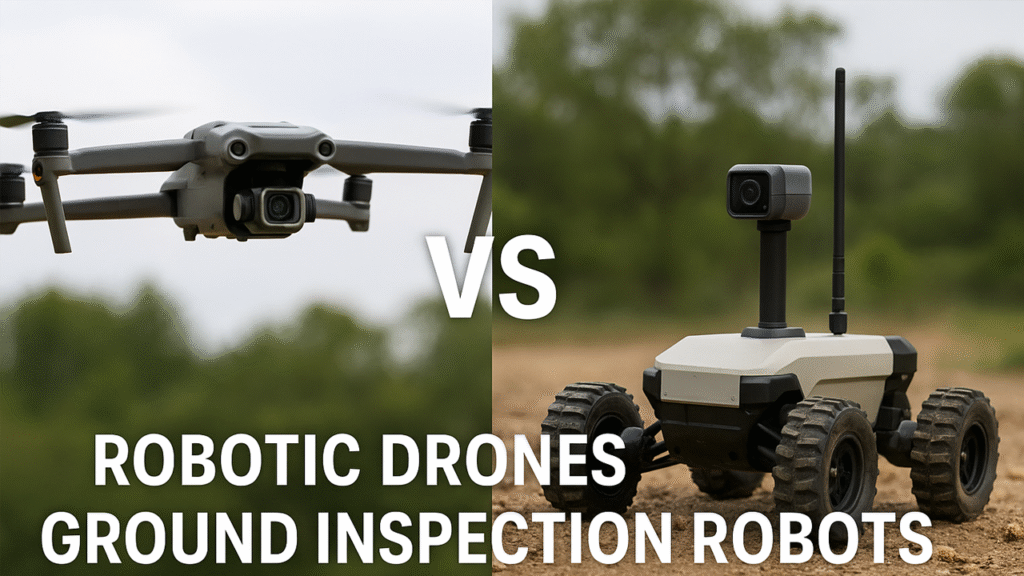
Robotic Drones vs Ground Inspection Robots – Which Should You Choose?
Introduction: The Automated Inspection Revolution
The industrial inspection landscape has undergone a remarkable transformation over the past decade. What once required teams of human inspectors equipped with clipboards, cameras, and safety harnesses can now be accomplished with sophisticated robotic systems. Two technologies have emerged as frontrunners in this revolution: aerial robotic drones and ground-based inspection robots. But which solution is right for your business?
This comprehensive guide explores the capabilities, advantages, limitations, and optimal use cases for both technologies. Whether you’re managing infrastructure, conducting facility inspections, or overseeing industrial operations, understanding these robotic solutions will help you make an informed investment decision that maximizes efficiency, safety, and return on investment.
Understanding Robotic Drones for Inspection
What Are Inspection Drones?
Robotic drones, also known as Unmanned Aerial Vehicles (UAVs) or Remotely Piloted Aircraft Systems (RPAS), are aircraft without human pilots aboard. Modern inspection drones are equipped with high-resolution cameras, thermal imaging sensors, LiDAR systems, and increasingly sophisticated AI-powered analytics capabilities. They can access hard-to-reach locations quickly and capture comprehensive visual data from perspectives previously impossible or extremely dangerous to obtain.
Key Capabilities of Inspection Drones
Vertical Access Excellence: Drones excel at inspecting tall structures such as wind turbines, telecommunications towers, building facades, bridges, and industrial chimneys. They can reach heights that would require expensive scaffolding, rope access technicians, or cherry pickers.
Large Area Coverage: With flight times ranging from 20 to 90 minutes depending on the model, drones can survey extensive areas rapidly. They’re ideal for pipeline inspections, solar farm assessments, agricultural monitoring, and large facility perimeter checks.
Advanced Sensor Integration: Modern inspection drones carry multiple sensor payloads including RGB cameras with up to 48MP resolution, thermal imaging cameras for detecting heat anomalies, multispectral sensors for vegetation analysis, and LiDAR for creating precise 3D models of structures and terrain.
Speed and Efficiency: Drones can be deployed quickly and cover ground much faster than human inspectors or ground robots. A roof inspection that might take a team of inspectors hours can be completed in minutes with a drone.
Advantages of Drone Inspections
Enhanced Safety: By removing the need for humans to work at height or in hazardous environments, drones significantly reduce workplace accidents and liability. Inspectors remain safely on the ground while the drone does the dangerous work.
Cost Effectiveness for Vertical Inspections: While the initial investment in drone technology can be substantial, the elimination of scaffolding, rope access teams, or crane hire often results in dramatic cost savings, particularly for repetitive inspections.
Minimal Operational Disruption: Drones can inspect active facilities with minimal disruption to operations. A power plant doesn’t need to shut down for a drone to inspect cooling towers or exhaust stacks.
Comprehensive Documentation: The ability to capture high-resolution imagery and video provides excellent documentation for compliance, insurance claims, and condition monitoring over time.
Limitations of Drone Inspections
Weather Dependency: Drones are significantly affected by weather conditions. High winds, rain, snow, and extreme temperatures can ground drone operations or compromise data quality. This can delay critical inspections and create scheduling challenges.
Regulatory Constraints: Aviation regulations vary by country and region, but most jurisdictions require operator certification, restrict flights near airports, limit beyond-visual-line-of-sight operations, and impose altitude restrictions. These regulations can limit where and when drones can operate.
Battery Life Limitations: Even the best commercial drones have limited flight times, typically between 20-40 minutes for inspection-grade systems. This necessitates multiple battery swaps for extensive inspections and limits the distance drones can travel from their launch point.
Indoor and Confined Space Challenges: While specialized indoor drones exist, navigating confined spaces, tunnels, or cluttered industrial environments presents significant challenges. GPS signals are unavailable indoors, requiring alternative navigation systems.
Surface Contact Limitations: Drones cannot perform physical testing that requires contact with surfaces, such as ultrasonic thickness testing, hardness testing, or collecting physical samples. They’re primarily visual inspection tools.
Understanding Ground Inspection Robots
What Are Ground Inspection Robots?
Ground inspection robots are autonomous or remotely operated mobile platforms designed to navigate terrestrial environments. They range from small, agile robots that can climb stairs and navigate complex terrain to larger platforms designed for specific industrial applications. These robots typically carry cameras, sensors, and sometimes manipulator arms that can perform physical interactions with their environment.
Key Capabilities of Ground Inspection Robots
Confined Space Access: Ground robots excel in environments where human access is dangerous, difficult, or impossible: underground pipes, sewers, ventilation systems, storage tanks, nuclear facilities, and industrial process areas. They can spend hours in hazardous atmospheres without risk to human life.
Physical Interaction: Unlike drones, many ground robots can interact physically with their environment. They can open valves, collect samples, perform contact-based testing, manipulate objects, and even perform simple maintenance tasks.
Extended Operation Time: Ground robots aren’t limited by battery-powered flight. Many can operate for several hours on a single charge, and tethered robots can operate indefinitely while receiving power through their connection cable.
Stable Platform for Precision Work: Operating on solid ground provides a stable platform for detailed inspections and precise sensor readings. This stability is crucial for high-magnification visual inspections and accurate sensor measurements.
All-Weather Capability: Ground robots are largely unaffected by weather conditions that would ground drones. They can operate in rain, snow, wind, and a wide range of temperatures, ensuring inspection schedules remain on track.
Advantages of Ground Inspection Robots
Hazardous Environment Specialists: Ground robots thrive in environments that are dangerous for humans: confined spaces with low oxygen, areas with toxic gases, radioactive zones, extreme temperatures, and explosive atmospheres. They’re the preferred choice for petrochemical facilities, nuclear installations, and mining operations.
Regulatory Freedom: Ground robots face far fewer regulatory restrictions than drones. No airspace permissions are required, and operations can typically proceed without the extensive licensing requirements that govern aerial operations.
Detailed Close-Range Inspection: The ability to position sensors inches from a surface enables extremely detailed inspections. Ground robots can detect minute cracks, corrosion patterns, and surface defects that might be missed by aerial inspection.
Data Collection Diversity: Many ground robots can carry a wider variety of sensors than drones due to weight limitations being less restrictive. They can perform ultrasonic testing, eddy current testing, magnetic particle inspection, and other non-destructive testing methods while also capturing visual data.
Reduced Operational Restrictions: Ground robots don’t require the same safety perimeters as drones. They can operate in active industrial environments with minimal disruption and without the risk of falling from height.
Limitations of Ground Inspection Robots
Terrain Restrictions: While advanced ground robots can navigate stairs, obstacles, and rough terrain, they cannot match the unrestricted movement of aerial drones. Extreme terrain, high steps, narrow gaps, or debris fields may prove impassable.
Speed of Coverage: Ground robots typically move slower than drones, especially when navigating complex environments. Inspecting large facilities or extensive areas takes considerably longer than aerial surveys.
Vertical Access Challenges: While some ground robots can climb structures or operate in vertical spaces, accessing high elevations remains their primary limitation compared to drones. Inspecting the top of a 100-meter chimney is outside their capability without specialized infrastructure.
Deployment Complexity: Some inspection scenarios require significant setup time for ground robots, particularly when accessing confined spaces or preparing safe deployment procedures. This contrasts with the relatively quick deployment of drones.
Limited Line of Sight: In complex environments with many obstacles, maintaining visual or radio contact with ground robots can be challenging, sometimes requiring additional relay stations or limiting operational range.
Comparative Analysis: Key Decision Factors
Inspection Environment
Choose Drones When:
- Inspecting tall structures (towers, wind turbines, building exteriors)
- Surveying large open areas (solar farms, pipelines, agricultural land)
- Assessing roofs and upper building structures
- Conducting perimeter security surveys
- Monitoring construction site progress
- Inspecting bridges from below or above
Choose Ground Robots When:
- Navigating underground infrastructure (sewers, tunnels, pipes)
- Inspecting confined spaces (tanks, vessels, ducts)
- Operating in hazardous atmospheres (low oxygen, explosive gases)
- Accessing areas with overhead obstructions
- Working in indoor industrial environments
- Requiring physical interaction with equipment
Inspection Requirements
Drones Excel At:
- Visual documentation from aerial perspectives
- Thermal imaging of large structures
- Photogrammetry and 3D modeling
- Rapid area mapping and surveying
- Change detection over time
- Volumetric calculations (stockpiles, excavations)
Ground Robots Excel At:
- Contact-based non-destructive testing
- Sample collection
- Gas detection and environmental monitoring
- Close-range detailed surface inspection
- Valve manipulation and basic maintenance
- Long-duration monitoring missions
Budget Considerations
Drone Investment Range:
- Entry-level inspection drones: £1,000 – £5,000
- Professional inspection systems: £5,000 – £25,000
- Enterprise solutions with advanced sensors: £25,000 – £100,000+
- Operator training and certification: £1,000 – £3,000
- Insurance: £500 – £5,000 annually
Ground Robot Investment Range:
- Basic inspection robots: £5,000 – £20,000
- Mid-range industrial robots: £20,000 – £75,000
- Specialized confined space robots: £75,000 – £250,000+
- Custom solutions: £250,000+
- Training typically included but customization adds cost
Operational Costs
Drones:
- Lower maintenance costs due to fewer moving parts
- Battery replacement every 6-12 months (£100-£500 per battery)
- Potential crash repairs and part replacements
- Software subscription fees for advanced analytics
- Ongoing regulatory compliance and pilot currency requirements
Ground Robots:
- Higher maintenance due to complex mechanical systems
- Track or wheel replacements based on terrain
- More robust construction generally means longer lifespan
- Sensor calibration and maintenance
- Lower insurance costs compared to drones
Industry-Specific Applications
Energy and Utilities
Drones Dominate:
- Wind turbine blade inspections
- Solar panel thermal surveys
- Transmission line inspections
- Substation infrastructure assessment
Ground Robots Dominate:
- Nuclear facility inspections
- Underground cable tunnel surveys
- Oil and gas pipeline internal inspections
- Confined space boiler and pressure vessel inspections
Construction and Infrastructure
Drones Dominate:
- Site progress monitoring
- Volumetric surveys
- Roof inspections
- Facade assessments
- Bridge inspections (exterior)
Ground Robots Dominate:
- Underground utility mapping
- Tunnel inspection during construction
- Foundation inspections
- Confined excavation monitoring
Manufacturing and Industrial
Drones Dominate:
- Large warehouse inventory management
- Facility security patrols
- Roof and ceiling inspections
- Outdoor tank farm surveys
Ground Robots Dominate:
- Production line monitoring
- Hazardous material storage inspection
- Equipment health monitoring in tight spaces
- Process vessel internal inspections
Public Infrastructure
Drones Dominate:
- Road and highway surveys
- Disaster assessment
- Large structure inspection (dams, bridges)
- Urban planning and development monitoring
Ground Robots Dominate:
- Sewer and drainage system inspection
- Water treatment facility assessment
- Underground transportation system monitoring
- Historic building interior documentation
The Hybrid Approach: Best of Both Worlds
Forward-thinking organizations increasingly recognize that the optimal solution often involves both technologies. A comprehensive inspection program might deploy drones for external, vertical, and large-area surveys while utilizing ground robots for confined spaces, hazardous environments, and detailed contact-based testing.
Complementary Deployment Strategy
Consider a petrochemical facility: drones can efficiently survey the external condition of processing towers, storage tanks, and piping racks, creating thermal maps to identify insulation issues and using photogrammetry to detect structural deformations. Meanwhile, ground robots enter confined spaces to inspect the interior of vessels, navigate pipe corridors to check for leaks and corrosion, and operate in potentially explosive atmospheres where human access is restricted.
This integrated approach maximizes the strengths of each technology while mitigating their individual limitations. Data from both platforms can be combined in digital twin environments, providing facility managers with comprehensive situational awareness.
Technology Maturity and Future Developments
Both drone and ground robot technologies continue to evolve rapidly. Artificial intelligence and machine learning are enhancing autonomous navigation, automatic defect detection, and predictive maintenance capabilities. Future systems will offer greater autonomy, longer operational times, improved sensor miniaturization, and better integration with facility management systems.
Emerging developments include:
- Autonomous charging stations enabling continuous operation without human intervention
- Swarm robotics where multiple robots coordinate to complete complex inspection tasks
- Advanced AI analytics that automatically identify and classify defects
- 5G connectivity enabling real-time high-definition video streaming and remote expert collaboration
- Hybrid designs combining aerial and ground capabilities in single platforms
Making Your Decision: A Structured Approach
Step 1: Define Your Inspection Requirements
Document specifically what you need to inspect, how often, what data you need to collect, what conditions robots will operate in, and what regulations apply to your industry.
Step 2: Assess Your Environment
Map your facility or inspection areas, identify access challenges, evaluate weather exposure, consider available infrastructure for robot deployment, and determine safety and regulatory constraints.
Step 3: Calculate Total Cost of Ownership
Look beyond purchase price to include training costs, maintenance and repair budgets, insurance requirements, software and data management, and potential cost savings from eliminating traditional inspection methods.
Step 4: Consider Your Team’s Capabilities
Evaluate existing technical expertise, availability for training, interest in adopting new technology, current workflow integration points, and resistance to change within your organization.
Step 5: Start Small and Scale
Rather than making a massive initial investment, consider starting with a pilot project. Rent or hire robots for initial trials to validate the technology suits your needs before committing to purchase. This approach allows you to learn what works, build internal expertise, and demonstrate ROI to stakeholders before scaling your program.
Expert Guidance: Why Professional Consultation Matters
Selecting between robotic drones and ground inspection robots represents a significant investment decision with long-term operational implications. The landscape of available technologies is vast and continually evolving. What works brilliantly for one organization may be entirely inappropriate for another, even within the same industry.
This is where expert consultation becomes invaluable. Professional robotics consultants bring:
- Vendor-Neutral Advice: Independent assessment of solutions without sales pressure
- Industry Experience: Insights from hundreds of implementation projects across diverse sectors
- Technical Expertise: Deep understanding of sensor capabilities, platform limitations, and integration requirements
- ROI Analysis: Realistic financial modeling based on actual deployment data
- Implementation Planning: Structured approaches to pilot projects, training, and scaling
- Vendor Selection Support: Navigation of the procurement process and contract negotiation
Beyond Technology Selection: Building Your Robotics Team
Even with the perfect technology choice, success ultimately depends on having skilled operators and maintenance personnel. The robotics talent market is competitive, and finding professionals with the specific expertise your operation requires can be challenging.
Professional robotics recruitment services understand this specialized market. They can help you:
- Identify the specific skills your operation needs
- Access networks of qualified robotics professionals
- Screen candidates for technical competency and cultural fit
- Navigate the competitive compensation landscape
- Plan for long-term team development and succession
The right people operating the right technology in the right way delivers transformational results. Investing in both appropriate technology and qualified personnel sets your robotics program up for sustainable success.
Take the Next Step
Whether you’re just beginning to explore robotic inspection solutions or looking to expand an existing program, expert guidance can save you time, money, and frustration. The decision between drones and ground robots—or the strategic deployment of both—requires careful analysis of your specific requirements, constraints, and goals.
Get Professional Support for Your Robotics Journey
Our team of robotics experts specializes in helping organizations like yours navigate the complex landscape of inspection robotics. We provide:
Robot Consultancy Services – Comprehensive needs assessment, technology evaluation and selection, vendor comparison and procurement support, implementation planning and project management, training program development, and ongoing optimization support.
Robot Recruitment Services – We connect you with skilled robotics professionals including drone pilots and operators, ground robot specialists, robotics engineers and technicians, data analysts for inspection data, and program managers for robotics initiatives.
Contact Us Today:
📧 Email: sales@robotcenter.co.uk
📞 Phone: 0845 528 0404
Schedule a consultation to discuss your inspection challenges and explore how robotic solutions can transform your operations. Our team will work with you to develop a customized approach that delivers measurable results.
Don’t navigate the robotics revolution alone. Partner with experts who understand both the technology and your business needs.
Article Sponsors
This article is brought to you by leading robotics organizations dedicated to advancing the adoption of robotic technologies:
Robot Center
Website: https://robotcenter.co.uk/
Robot Center is your comprehensive resource for robotics solutions. Services include:
- Buy Robot: Extensive selection of commercial and industrial robots
- Robot Buy: Expert guidance through the purchasing process
- Robot Consultancy: Strategic planning and implementation support
- Robotics Consultancy: Technical expertise across all robotics domains
Whether you’re purchasing your first robot or expanding an enterprise-scale robotics program, Robot Center provides the expertise and solutions you need.
Robots of London
Website: https://robotsoflondon.co.uk/
Robots of London specializes in flexible robotics access solutions:
- Robot Hire: Short and long-term robot rental options
- Robot Rental: Cost-effective access to cutting-edge robotics
- Rent Robot: Try before you buy programs
- Hire Robot: Event demonstrations and temporary deployments
- Robot Events: Showcase robotics at conferences, exhibitions, and corporate events
Perfect for organizations wanting to pilot robotics technology before committing to purchase, or for one-time projects requiring specialized equipment.
Robot Philosophy (RoboPhil)
Website: https://robophil.com/
Founded by Philip English, Robot Philosophy combines deep technical expertise with accessible education:
- Robot Consultancy: Strategic advisory services for robotics adoption
- Robot Recruitment: Connect with top robotics talent
- Robot Advice: Practical guidance from real-world implementation experience
- Robot Insights: Industry trends and technology analysis
- Robot Ideas: Innovation workshops and ideation sessions
About Philip English (RoboPhil): Philip English is a leading Robot YouTuber, Robot Influencer, Robot Trainer, Robot Consultant, and Robot Streamer. Through his platforms as a Robotics Streamer, Robotics YouTuber, Robotics Influencer, Robotics Consultant, and Robotics Trainer, Philip makes complex robotics accessible to diverse audiences—from beginners exploring the field to enterprises implementing sophisticated automation solutions.
Conclusion
The choice between robotic drones and ground inspection robots isn’t about which technology is superior—it’s about which solution aligns best with your specific operational requirements. Drones offer unmatched advantages for vertical access, large area coverage, and rapid deployment. Ground robots excel in confined spaces, hazardous environments, and applications requiring physical interaction.
Many organizations discover that a hybrid approach, deploying both technologies strategically, provides the most comprehensive inspection capability. As these technologies continue to mature and become more accessible, the organizations that adopt them thoughtfully—with expert guidance and qualified personnel—will lead their industries in safety, efficiency, and operational excellence.
The future of inspection is robotic. The question isn’t whether to adopt these technologies, but how to implement them most effectively for your unique circumstances. With the right expertise supporting your journey, you can navigate this transformation confidently and realize substantial returns on your investment.
Contact us today to begin your robotics transformation journey.
For more information about robotic inspection solutions, consultancy services, or recruitment support, email sales@robotcenter.co.uk or call 0845 528 0404 to schedule your consultation.
https://www.youtube.com/watch?v=9uKL0O9akVs