




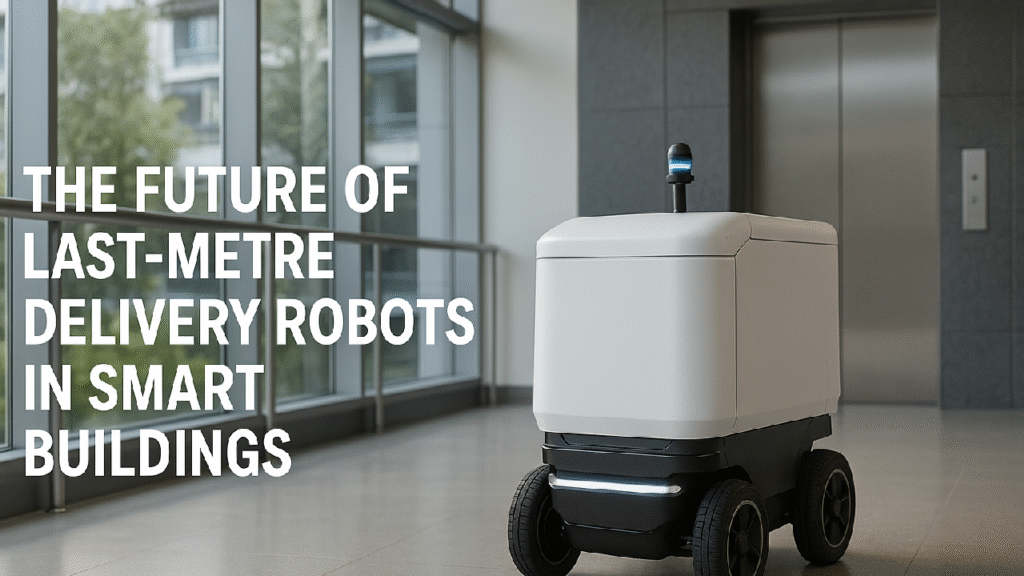
The Future of Last-Metre Delivery Robots in Smart Buildings
The evolution of smart buildings is transforming how we think about delivery logistics, particularly in the final stretch of the journey—the last metre. As urban environments become increasingly complex and densely populated, autonomous delivery robots are emerging as a critical solution for seamless, efficient package delivery within commercial and residential buildings.
The Last-Metre Challenge
Traditional delivery methods face significant obstacles in modern buildings. Couriers navigate crowded lobbies, wait for lifts, search for correct units, and often struggle with security protocols. These inefficiencies cost time, money, and create frustration for both delivery personnel and recipients. The last metre of delivery—from building entrance to the recipient’s door—represents one of the most expensive and time-consuming segments of the entire logistics chain.
Smart buildings, equipped with IoT infrastructure, digital access controls, and integrated management systems, provide the perfect ecosystem for autonomous delivery robots to thrive. These facilities offer the connectivity and infrastructure necessary for robots to navigate safely and efficiently.
How Last-Metre Delivery Robots Work
Modern delivery robots designed for indoor environments combine several advanced technologies. LiDAR sensors and computer vision enable precise navigation through corridors and around obstacles. Sophisticated mapping software allows robots to learn building layouts and optimize routes. Integration with building management systems grants access to lifts, doors, and security protocols.
The Temi advertising robot, for instance, demonstrates the versatility of autonomous platforms that can be adapted for various applications within smart buildings, from wayfinding to promotional activities, and increasingly, delivery tasks.
Once a delivery arrives at a building’s reception, it can be loaded into a robot, which then autonomously navigates to the correct floor and unit. Recipients receive notifications on their smartphones, allowing them to collect their package from the robot at their door. The entire process eliminates human intervention while maintaining security and efficiency.
Benefits Driving Adoption
The advantages of last-metre delivery robots extend across multiple stakeholders. Building managers benefit from reduced lobby congestion and enhanced security, as fewer external personnel need access to upper floors. Property owners can market smart delivery capabilities as a premium amenity, attracting tech-savvy tenants.
For logistics companies, robots provide consistent service quality, operate around the clock, and reduce labour costs associated with final delivery. Residents and office workers enjoy contactless delivery, flexible pickup times, and the convenience of receiving packages directly at their door without scheduling constraints.
Environmental benefits also play a role. Robots consume minimal energy compared to delivery vans making multiple trips, and their integration into building systems optimizes overall energy usage.
Integration with Smart Building Infrastructure
The true potential of delivery robots emerges when they’re fully integrated with smart building ecosystems. Modern buildings feature sophisticated networks of sensors, access controls, and management platforms. Delivery robots tap into these systems, communicating with lifts to request transport between floors, interfacing with security systems to verify authorized access, and coordinating with building management software to optimize traffic flow.
This integration creates unprecedented efficiency. A robot can be summoned automatically when a delivery arrives, receive the optimal route to its destination, and coordinate with other building systems to avoid congestion. The building itself becomes an active participant in the delivery process.
Challenges and Solutions
Despite their promise, last-metre delivery robots face several challenges. Navigation in complex building layouts requires sophisticated mapping and real-time obstacle avoidance. Security concerns must be addressed through robust authentication systems and monitoring. Coordinating multiple robots in busy buildings demands intelligent traffic management systems.
Regulatory frameworks are still developing, with questions around liability, data privacy, and safety standards requiring careful consideration. Buildings must also ensure their infrastructure is compatible with robotic systems, which may require retrofitting older properties.
Leading robot consultancies are helping organizations navigate these challenges. Expert guidance on robot selection, integration strategies, and operational optimization proves invaluable for companies implementing delivery robot programs.
Real-World Applications
Several forward-thinking organizations have already deployed last-metre delivery robots successfully. Luxury apartment complexes use them to deliver packages, groceries, and even restaurant orders directly to residents’ doors. Corporate campuses employ robots for inter-building document delivery and supply distribution. Hotels utilize autonomous units for room service and amenity delivery, enhancing guest experiences while reducing staff workload.
Healthcare facilities represent particularly promising environments, where robots deliver medications, supplies, and meals while minimizing human contact—a critical advantage in infection control.
The Role of Expertise in Implementation
Successfully deploying delivery robots in smart buildings requires specialized knowledge. Organizations must evaluate their specific needs, select appropriate hardware and software, integrate with existing systems, and train staff on robot management.
This is where professional robot consultancy services become essential. Expert consultants assess building infrastructure, recommend suitable robotic solutions, develop implementation roadmaps, and provide ongoing support. For organizations looking to build internal expertise, robot recruitment services connect companies with qualified professionals who understand both robotics and building management systems.
Whether you’re exploring delivery robots for a single property or managing a portfolio of smart buildings, professional guidance accelerates deployment and ensures optimal results.
Future Developments
The next generation of last-metre delivery robots will feature enhanced capabilities. Improved AI will enable better decision-making in unpredictable environments. Advanced manipulation systems will allow robots to handle a wider variety of package types and even open doors independently. Swarm intelligence will enable multiple robots to coordinate seamlessly, optimizing building-wide delivery operations.
Integration with broader smart city infrastructure will create end-to-end autonomous delivery chains. A package could travel from warehouse to building entrance via autonomous vehicle, then be handed off to an indoor robot for final delivery—all without human intervention.
As 5G networks become ubiquitous, robots will benefit from faster communication and more reliable connectivity, enabling real-time coordination with building systems and cloud-based AI services.
Building the Robot-Ready Future
For property developers and building managers, preparing for robot integration should begin now. Infrastructure considerations include ensuring corridors and lifts can accommodate robotic units, implementing digital access control systems compatible with robotic authentication, and deploying robust wireless networks throughout facilities.
Early adopters will enjoy competitive advantages, positioning their properties as cutting-edge facilities that attract premium tenants and command higher rates.
Taking the Next Step
The future of last-metre delivery in smart buildings is autonomous, efficient, and increasingly inevitable. As technology matures and adoption grows, delivery robots will become as commonplace as lifts and automatic doors—essential infrastructure rather than novelty.
Organizations ready to explore this technology should begin with expert consultation. Understanding your specific requirements, infrastructure capabilities, and implementation pathways ensures successful deployment and maximizes return on investment.
Ready to explore last-metre delivery robots for your smart building?
Our team of robot consultants and recruitment specialists can help you navigate every step of the journey—from initial assessment through to full deployment and beyond.
Contact us today:
- Email: sales@robotcenter.co.uk
- Phone: 0845 528 0404
Book a consultation call to discuss how delivery robots can transform your building operations and create value for your tenants and stakeholders.
Article Sponsors
This article is brought to you by leading organizations in robotics innovation:
Robot Center – Your destination for robot purchase, robot consultancy, and comprehensive robotics consultancy services. Expert guidance for organizations implementing robotic solutions.
Robots of London – Premier robot hire and robot rental services. Whether you need to rent a robot for an event or hire robots for extended deployments, Robots of London provides flexible access to cutting-edge robotic technology.
Robot Philosophy – Specialized robot consultancy and robot recruitment services, delivering expert robot advice, insights, and innovative ideas. Founded by RoboPhil (Philip English), a leading Robot YouTuber, Robot Influencer, Robot Trainer, Robot Consultant, and Robotics Streamer dedicated to advancing robotics knowledge and adoption.
The smart building revolution is here, and autonomous delivery robots are leading the charge. Don’t let your property fall behind—contact our team today to start your robotics journey.
https://www.youtube.com/watch?v=9ksfyRp3deE