




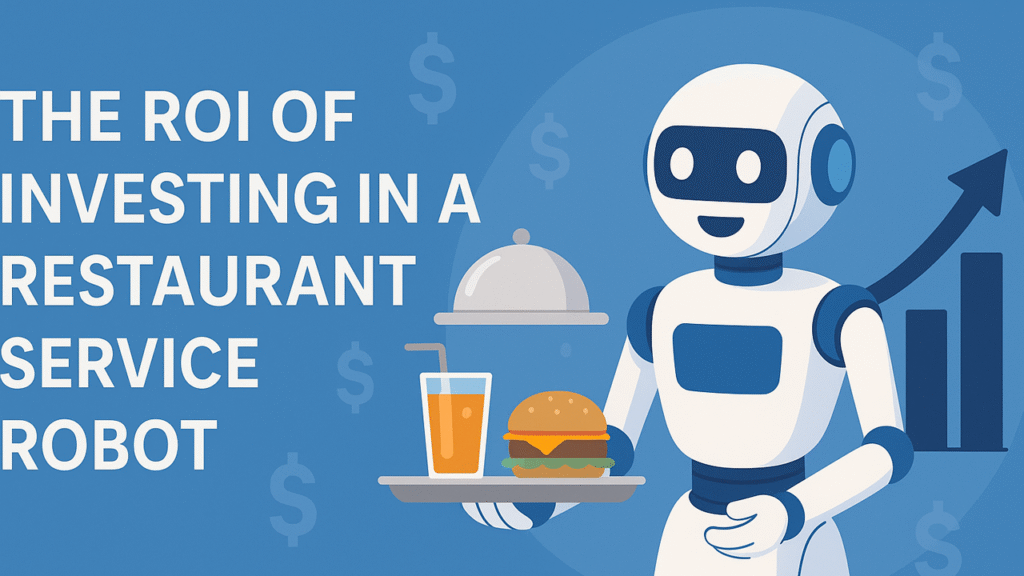
The ROI of Investing in a Restaurant Service Robot
In an era of staffing shortages, rising labour costs, and increasing guest expectations for novelty and speed, restaurants are looking to automation not just as a gimmick—but as a serious value driver. The question on every owner’s mind is: “Will a service robot pay for itself — and beyond?”
In this article we break down the return-on-investment (ROI) equation, review real world data, and make the business case. At the same time, we’ll explain how Robot Center, Robots of London, and Robot Philosophy can help you in every step — from feasibility and selection to deployment, recruiting, and staffing. If you’d like to discuss a tailored project, please email sales@robotcenter.co.uk or call 0845 528 0404 to book a discovery call.
Why Restaurant Service Robots Are Gaining Traction
Before diving into numbers, let’s establish the value proposition of restaurant service robots:
Labor cost control and consistency
Robots don’t demand overtime pay, shift differentials, benefits, sick leave, or holiday pay. They work reliably, at consistent performance levels, 24/7 (with downtime for maintenance). This stability helps smooth operations and shrink hidden scheduling inefficiencies.
Robots also reduce human error in order delivery, spills, or misplacement.Mitigating employee turnover and training costs
The hospitality sector suffers notoriously high turnover—recruiting, onboarding, and training new staff is an ongoing cost. A robot’s “turnover” cost is far lower (mainly maintenance, updates, or replacement).
In one case study, the combined recruiting, training, and compensation cost for two part-time roles in a food service scenario was estimated at USD 33,100 per year. By contrast, a single robot lease or deployment in that role could cost far less over a multi-year span. Culinary Services GroupNew customer appeal and marketing advantage
Robots are eye-catching, generate social media buzz, and can become a unique selling point. The novelty factor can draw new customers, increase dwell time, or stimulate repeat visits. In one bakery case study, robot recommendation intervention correlated with measurable sales uplift. arXivOperational efficiency beyond labour
Robots can integrate with order management systems, optimize routing through algorithms, reduce waste from failed deliveries or mixups, and enhance throughput during peak times. They can also help reduce staff “dead time” (walking, waiting, etc.).Scalability and predictability
Once you invest in the robotic infrastructure, scaling is simpler: you add more units rather than scaling headcount with all the complexity of hiring, training, scheduling. ROI becomes more predictable.Faster payback due to decreasing robot costs
As robotic hardware and software become commoditized, costs are declining. Many providers now claim anticipated payback periods under 12 months for fast food or limited-service settings. Hyper
According to industry observers, some restaurants may reduce labor costs by 30% to 70% via smart automation. aaronallen.com In another pilot, robotic “food runners” in a dining environment delivered a labor ROI of up to 124% (i.e. more than recouping their cost) in that use case. seniorhousingnews.com
But those are headline numbers. The real ROI depends on your setup, margins, throughput, robot pricing model, and integration approach. Let’s break it down.
Modeling ROI: How to Calculate the Payback
To compute ROI, you want a structured approach. Here’s a simple formula:
ROI = (Net gains from robot – total investment cost) ÷ total investment cost
A more useful metric is payback period (i.e. how many months until cumulative gains cover total cost).
Components of Costs & Gains
Costs (investment side)
Capital cost or lease cost of the robot(s)
Integration costs (software, API work, POS/ERP connectivity)
Infrastructure adjustments (power, routing floor markings, charging stations)
Training staff to work alongside the robot
Maintenance, repair, parts, insurance
Software licensing, updates, cloud services
Depreciation or refresh cost
Gains / Savings
Labor savings (reduced headcount or reallocation)
Reduced overtime, fewer mistakes, less waste
Lower turnover and training cost
Increased revenue from throughput or guest volume (if any)
Marketing or “halo” effect (e.g. more foot traffic)
Operating efficiency value (speed, customer satisfaction)
Example Scenario (Illustrative)
Suppose a mid-size restaurant with moderate traffic is considering one service robot to assist with food delivery from kitchen to tables.
Assume:
Robot (purchase or long lease): £18,000
Integration, training, floor prep: £5,000
Annual maintenance / software / parts: £1,800
Lives: 5 years
Labour baseline:
The restaurant currently spends £60,000/year on wait staff cost for that workload (salary, holidays, social costs).
They expect robot to reduce wait staff need by 30%, i.e. saving £18,000/year.
Additional hidden saving: cut of turnover/training costs, assume £2,000/year.
Some service/marketing uplift of say £3,000/year from novelty.
Year 1 cost: £18,000 + £5,000 = £23,000
Year 1 savings: £18,000 + £2,000 + £3,000 = £23,000
Net zero in year 1 (i.e. payback in ~12 months)
Years 2–5: each year net gain ~ £23,000 – £1,800 (maintenance) = £21,200
So over 5 years, total net gain ~ £21,200 × 4 + 0 = £84,800
ROI = £84,800 / £23,000 = ~369%
Thus the investment would return nearly four times over 5 years.
This is a simplified illustration; real numbers will vary. But many manufacturers and automation thought leaders now claim payback windows below 12 months in fast food or high throughput settings. Hyper+1
Case Studies & Empirical Evidence
Food Service Robot vs Human Roles (Case Study)
One case study compared the cost of two part-time human roles (~42 hours/week combined) costing USD 33,100 per year (including training and turnover) against deploying a robot via lease (~USD 11,700 first year). Over three years, the robot scenario showed a favorable ROI. Culinary Services Group
Robotic Food Runner in Senior Living / Dining
A pilot in a senior living environment saw a 124% labor ROI for robotic food runners in dining—meaning that the gains more than offset the costs. seniorhousingnews.com
Bakery Robot Uplift
In a bakery store setting, a robot stationed inside recommending items delivered measurable uplift in sales compared to baseline periods. arXiv
Market Trends & Forecasts
Analysts estimate that the automation trend in restaurants will accelerate as labor costs rise and robot costs fall. Some forecasts suggest 30–70% labor cost reduction is feasible in food operations. aaronallen.com
Key Variables That Drive / Risk the ROI
To ensure you get the best ROI, you must manage these levers and risks:
Robot pricing model
Upfront purchase vs lease vs robot-as-a-service (RaaS)
Software licensing or per-transaction fees
Maintenance contracts
A high lease or hidden software fee can erode your margin.
Utilization / throughput
The more the robot is used in peak times, the faster payback. Idle time is wasted ROI.Integration cost
If your POS, order management, routing, or kitchen systems are incompatible, integration can balloon.Operating reliability & downtime
Frequent breakdowns, delays or maintenance can erode savings.Human–robot coordination
The robot is rarely 100% autonomous; humans still assist, supervise, or monitor. Efficiency depends on seamless collaboration.Customer acceptance & UX
If guests find robots awkward, slow, or confusing, the novelty loses impact. Thoughtful UX (e.g. trajectory, intention signalling) matter. A recent academic study found that robot movement path and visual cues greatly influence customer perception and accuracy of delivery. arXivObsolescence / refresh cycle
In fast-moving robotics, hardware becomes outdated. Plan for refresh or upgrades.Regulatory / insurance / safety costs
You need to comply with local regulations (e.g. safety, accessibility) and manage liability.
By optimizing these variables, you can tilt ROI strongly in your favour.
How to Accelerate and Safeguard Your ROI
Here are strategies we recommend (and services we offer) to maximise outcome:
1. Pilot test before full deployment
Start with a single unit in a well-controlled environment (e.g. a flagship location) to refine routing, integration, and guest interactions. Use that data to scale deployment.
2. Intelligent routing / path planning
Use dynamic navigation and path optimization so the robot takes the fastest route and avoids collisions or bottlenecks.
3. Human + robot hybrid workflow
Rather than replacing staff outright, use robots for high‐footfall, repetitive tasks (e.g. delivering food) and free human staff to focus on guest engagement, upselling, etc.
4. Continuous monitoring, analytics & feedback
Use telemetry and data to track robot uptime, failed deliveries, guest interactions, error rates. Feed that data into improvement loops.
5. Marketing & narrative around the robot
Leverage the novelty to drive social media, PR, experience differentiation, perhaps even premium pricing or event marketing.
6. Plan refresh & modular upgrades
Choose a modular architecture (e.g. swappable sensors, software upgrades) to avoid wholesale replacement.
7. Staff buy-in & training
Ensure staff are comfortable working alongside robots, know fallback protocols, and can assist when the robot needs intervention.
Why You Need Expert Assistance (and Why Free DIY Isn’t Enough)
This is where Robot Center, Robots of London, and Robot Philosophy come in. Transitioning from concept to profitable deployment is complex. Even minor missteps in selection, integration, or staffing can twist good ROI into a cautionary tale. Below are ways we help, and why outsourcing to experts matters.
Robot Center – Consultancy & Buy / Robot Buy
As your trusted robotics consultancy partner, Robot Center can:
Conduct a feasibility and ROI study for your restaurant(s)
Evaluate robots from multiple vendors, comparing specs, pricing, reliability
Manage integration planning with your POS / kitchen / middleware
Oversee pilot deployment and scaling
Provide ongoing support, upgrades, and strategy
Help you procure (buy or lease) with negotiation leverage
Your investment becomes safer and better informed when guided by experienced consultants.
Robots of London – Robot Hire / Rental / Events
If you’d rather test robotics with lower upfront risk, Robots of London offers:
Robot hire / rental for short to medium term
Event deployments (e.g. robot waiter for a special night)
Temporary augmentation (e.g. during peak times or seasonal surges)
This lets you validate the ROI in your real environment before committing to purchase.
Robot Philosophy – Consultancy & Recruitment / Robot Recruitment
One of the biggest hidden challenges is staffing robots — you need robotics engineers, integrators, maintenance technicians, programmers, support staff. Robot Philosophy brings:
Robotics recruiting expertise (sourcing the right talent)
Consultancy in designing role profiles, skills matrices, org alignment
Ongoing training, ideation, insights, and support from “RoboPhil” (Philip English)
Thought leadership, content, and strategic guidance
In short: we help you not only deploy robots, but build the team to support them for the long term.
Sample 3-Step Roadmap to Get Started
Here’s a recommended phased roadmap:
Phase 1: Discovery & Feasibility (4–6 weeks)
Baseline your current labor, throughput, error rates
Select candidate restaurant(s) for pilot
Identify a shortlist of robot vendors
Estimate ROI and payback
Define integration and system architecture
At the end, you’ll have an “investment-grade” business case.
Phase 2: Pilot & Validation (3–6 months)
Deploy one or two units in your setting
Monitor usage, failures, throughput
Solicit guest feedback and staff input
Refine routing, fallback strategy, UX
Analyze real ROI metrics
Phase 3: Rollout & Scaling
Deploy across locations in waves
Monitor performance, maintain upgrades
Recruit or train a robotics support team
Build data dashboards, predictive maintenance
Leverage marketing & promotional tie-ins
Throughout all phases, Robot Center / Robot Philosophy consultants can guide and co-manage. Robots of London can supply rental units during pilot or scaling phases to minimise capital risk.
Sample ROI Scenarios (UK / GBP-based)
Here are two illustrative scenarios in a UK restaurant context:
Scenario A: Casual Dining, Moderate Volume
Current wait staff cost (for service tasks): £80,000/year
Robot reduces required staffing by 25% → savings £20,000/year
Additional uplift via novelty / marketing: £5,000/year
Robot capital cost + integration: £25,000
Annual maintenance: £2,000
Payback:
Year 1 net = £20,000 + £5,000 – £2,000 = £23,000 → in ~1.1 years you break even
Years 2–5 net = £23,000 per year → cumulative ~£92,000 over 5 years
ROI over 5 years = (~£92,000 – £25,000) / £25,000 = 268% (i.e. ROI ≈ 2.7×)
Scenario B: High-throughput, Quick Service / Fast Casual
Wait staff cost: £150,000/year
Robot reduces staffing by 40% → savings £60,000/year
Uplift from volume / speed: £10,000/year
Robot + integration: £35,000
Maintenance: £3,000/year
Payback:
Year 1 net = £60,000 + £10,000 – £3,000 = £67,000 → payback in ~0.5 years
Years 2–5 net = £67,000 → ~£268,000 cumulative
ROI = (£268,000 – £35,000) / £35,000 = 665% (i.e. ~6.6× return)
These are hypothetical, but entirely plausible in a high-volume context, especially as robot hardware costs decline.
Overcoming Objections & Mitigations
“Robots are too expensive / risky.”
Mitigation: Start with rentals via Robots of London, pilot before scaling; structure deals to include maintenance, upgrades, or replacement warranties.
“Guests will find them awkward / cold.”
Mitigation: Focus on UX. Use intention signalling (e.g. lights, display, trajectory) so guests intuit what the robot is doing. A recent study showed that visual cues and movement path dramatically influence user acceptance and accuracy of delivery. arXiv
“We don’t have robotics staff.”
Mitigation: Use Robot Philosophy’s recruitment and consultancy services to build or outsource the team you need. Don’t rely solely on your existing staff.
“Integration will be a nightmare.”
Mitigation: Involve robotics consultants early (Robot Center), perform integration planning, build middleware adapters, and start with robust APIs.
“The ROI is uncertain.”
Mitigation: Use a pilot phase to gather real data, adjust assumptions, then scale with confidence.
Why Working With Us Ensures Better ROI
We reduce questionable decisions (wrong robot, poor routing, oversizing)
We help you avoid hidden costs (integration traps, liability, poor staffing)
We provide domain experience in robotics deployment and restaurant workflows
We support not only the hardware and software side but also recruitment and team building
We build the roadmap so you scale safely rather than gamble
Let us help you maximize return and minimize risk.
Next Steps: Let’s Talk
If you’re serious about evaluating robot deployment, here’s how to proceed:
Book a discovery call with our team: 0845 528 0404
Email us at sales@robotcenter.co.uk with some high-level metrics (staff cost, footfall, concept type)
We’ll prepare a customized ROI framework and roadmap
Use Robot Center, Robots of London, and Robot Philosophy as your integrated solution partners — from consultation, robot sourcing, pilot, recruitment, and team support
Together, we can chart out your path to profitable automation.
Sponsors & Partner Profiles
Robot Center (https://robotcenter.co.uk/) — your trusted partner for buying robots, robot consultancy, and robotics advisory.
Robots of London (https://robotsoflondon.co.uk/) — specialists in robot hire, robot rental, robot events and short-term deployment.
Robot Philosophy (https://robophil.com/) — consultancy and recruitment services from RoboPhil (Philip English), a leading robotics influencer, trainer, and strategist.
Let’s transform your restaurant experience with robotics, and make the ROI work for you.
https://www.youtube.com/watch?v=iVQB6Kb92Io
https://www.youtube.com/shorts/rZG-SDYzgVw