




The Technology Behind Temi-Go’s Navigation and Sensors
The world of autonomous service robots has evolved dramatically in recent years, and at the forefront of this revolution stands the Temi-Go robot. This sophisticated mobile platform combines cutting-edge navigation technology with advanced sensor arrays to create a truly autonomous assistant capable of navigating complex indoor environments with remarkable precision and safety.
Understanding Temi-Go’s Navigation Architecture
At the heart of Temi-Go’s impressive mobility lies a sophisticated navigation system built on SLAM (Simultaneous Localization and Mapping) technology. This approach allows the robot to construct detailed maps of its environment while simultaneously tracking its own position within that space—a feat that requires substantial computational power and sensor integration.
The navigation system operates through multiple layers of processing. First, the robot continuously scans its surroundings, building and updating a real-time map of the environment. Second, it uses this map alongside its sensor data to determine optimal paths to destinations while avoiding obstacles. Finally, the system manages the robot’s actual movement, adjusting speed and trajectory in response to dynamic changes in the environment.
What makes Temi-Go particularly impressive is its ability to handle real-world complexities. Unlike robots that rely solely on pre-mapped environments, Temi-Go adapts to changes such as moved furniture, temporary obstacles, or crowded spaces. This flexibility makes it ideal for deployment in dynamic settings like offices, healthcare facilities, retail environments, and hospitality venues.
The Sensor Suite: Eyes and Ears of Autonomy
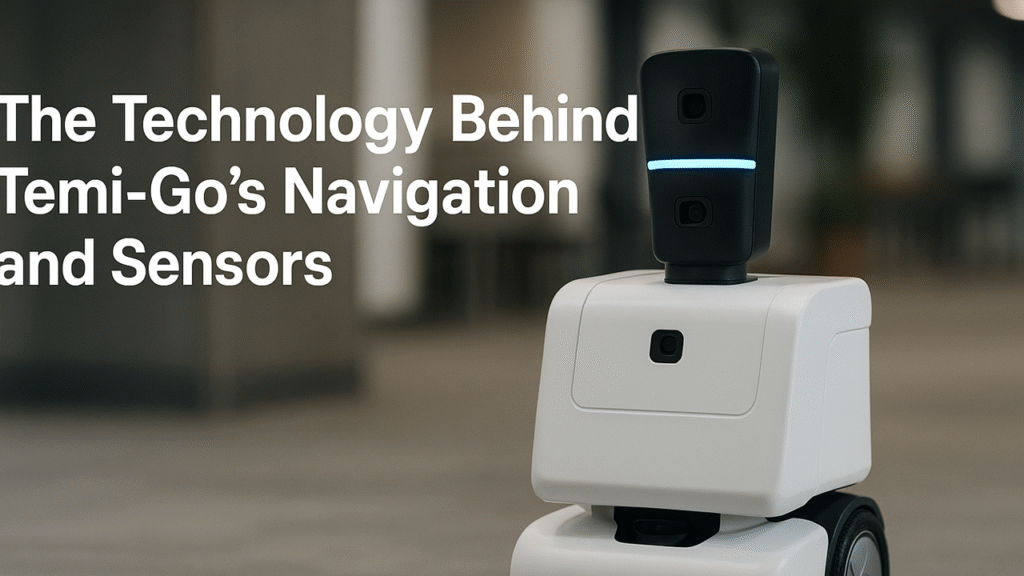
Temi-Go’s autonomous capabilities depend on a comprehensive array of sensors working in concert to provide complete environmental awareness. The sensor suite typically includes multiple technologies, each serving specific purposes in the navigation and safety ecosystem.
LiDAR (Light Detection and Ranging) forms the backbone of Temi-Go’s spatial awareness. This sensor rapidly emits laser pulses and measures their return time to create precise 3D maps of the surrounding environment. LiDAR excels at detecting obstacles, measuring distances with millimeter accuracy, and operating effectively in various lighting conditions. The 360-degree coverage provided by Temi-Go’s LiDAR system ensures the robot maintains awareness of its complete surroundings.
Depth cameras complement the LiDAR by providing visual depth perception. These cameras capture rich 3D information about the environment, helping the robot distinguish between different types of obstacles and understand spatial relationships. Combined with traditional RGB cameras, depth sensors enable advanced computer vision capabilities including object recognition and gesture detection.
Proximity sensors serve as the robot’s short-range detection system, particularly important for low-lying obstacles that might escape other sensors’ detection. These sensors provide an additional safety layer, triggering emergency stops if the robot approaches an obstacle too closely.
Wheel encoders track the rotation of Temi-Go’s wheels with high precision, providing critical data for odometry—the robot’s ability to estimate its position based on movement. While odometry alone accumulates errors over distance, when fused with other sensor data through the SLAM system, it contributes to highly accurate localization.
Inertial Measurement Units (IMUs) consisting of accelerometers and gyroscopes detect changes in velocity and orientation. These sensors help the robot understand its movement dynamics, maintain balance, and provide smooth motion control even when transitioning between different floor surfaces.
Sensor Fusion: Creating a Unified Environmental Model
The true sophistication of Temi-Go’s navigation lies not in individual sensors but in how their data is combined through sensor fusion algorithms. Each sensor has strengths and weaknesses—LiDAR excels at precise distance measurement but provides no color information, cameras offer rich visual data but struggle with depth perception, and IMUs track motion but cannot detect external obstacles.
By intelligently combining data from all sensors, Temi-Go creates a unified, robust understanding of its environment that surpasses what any single sensor could provide. Advanced algorithms filter noise, resolve conflicts between sensor readings, and generate high-confidence environmental models that drive navigation decisions.
This sensor fusion approach also provides redundancy. If one sensor is temporarily obscured or malfunctions, the system can continue operating using data from other sensors, ensuring reliable performance in diverse conditions.
Real-World Navigation Challenges and Solutions
Autonomous navigation in real-world environments presents numerous challenges that Temi-Go’s technology addresses through intelligent design. Reflective surfaces like glass walls and mirrors can confuse sensors by returning false readings. Temi-Go’s multi-sensor approach mitigates this issue, as different sensors respond differently to reflective materials, allowing the system to identify and discount spurious readings.
Crowds of people create constantly changing obstacles that require dynamic path planning. Temi-Go employs predictive algorithms that anticipate pedestrian movement, enabling the robot to navigate crowded spaces smoothly while maintaining comfortable social distances.
Variable lighting conditions pose challenges for vision-based systems. Temi-Go’s reliance on LiDAR as a primary sensor ensures consistent performance regardless of ambient lighting, while its cameras adapt to different light levels to maintain visual capabilities.
Floor transitions between carpet, tile, and other surfaces require careful handling to prevent navigation errors. Temi-Go’s wheel encoders and IMUs detect these transitions, allowing the navigation system to adjust its movement model accordingly and maintain accurate localization.
Autonomous vs. Semi-Autonomous Operation
While Temi-Go excels at autonomous navigation, it also offers semi-autonomous modes that balance independence with human control. Users can direct the robot to specific locations using voice commands or the touchscreen interface, with the robot handling all navigation details autonomously. Alternatively, operators can use remote control features when precise positioning is required or when navigating entirely novel environments.
This flexibility makes Temi-Go adaptable to various deployment scenarios. In well-mapped, routine environments, full autonomy maximizes efficiency. In dynamic or unpredictable situations, human oversight provides an additional layer of intelligence and decision-making.
Safety Features and Compliance
Safety remains paramount in autonomous mobile robotics, and Temi-Go incorporates multiple safety layers. Emergency stop capabilities ensure immediate cessation of movement if dangers are detected. Collision avoidance algorithms create safety buffers around the robot, preventing contact with people or objects. Speed limiting in crowded areas reduces kinetic energy and provides more reaction time. Acoustic warnings alert people to the robot’s presence and intended movements.
These safety features help Temi-Go comply with relevant safety standards and regulations for service robots, providing peace of mind for organizations deploying the technology in public-facing environments.
The Future of Navigation Technology
The navigation and sensor technologies powering Temi-Go continue to evolve. Future developments may include enhanced AI capabilities for better prediction of human behavior, integration with building management systems for optimized routing, swarm intelligence allowing multiple robots to coordinate movements, and improved outdoor navigation extending Temi-Go’s operational envelope beyond indoor spaces.
As these technologies mature, autonomous service robots like Temi-Go will become increasingly capable, versatile, and integral to modern operations across industries.
Implementing Temi-Go in Your Organization
Understanding the sophisticated technology behind Temi-Go is just the beginning. Successfully implementing autonomous robots requires careful planning, integration expertise, and ongoing optimization. Whether you’re exploring robotics for the first time or looking to expand your existing robot fleet, professional guidance can make the difference between a successful deployment and a frustrating experience.
Need Expert Guidance? Our robot consulting services help organizations navigate every aspect of robotics implementation—from initial needs assessment and robot selection to deployment planning and staff training. We bring deep technical expertise and practical experience to ensure your robotics investment delivers maximum value.
Looking for Robotics Talent? Building an effective robotics operation requires people with specialized skills. Our robot recruitment service connects you with qualified professionals who understand autonomous systems, can manage robot fleets, and drive your robotics initiatives forward.
Ready to Discuss Your Robotics Project? Contact our team to explore how Temi-Go and other autonomous robots can transform your operations. We’re here to answer your questions and help you develop a robotics strategy tailored to your specific needs.
📧 Email: sales@robotcenter.co.uk
📞 Phone: 0845 528 0404
Article Sponsors
This article is brought to you by leading robotics organizations in the UK:
Robot Center – Your destination for purchasing robots and accessing expert robotics consultancy services. Whether you’re looking to buy robots for your business or need strategic guidance on robotics implementation, Robot Center provides comprehensive solutions and support.
Robots of London – Specializing in robot hire and rental services for events, exhibitions, and short-term deployments. Rent robots for your next corporate event, trade show, or special occasion and experience the impact of robotics without long-term commitment.
Robot Philosophy – Founded by RoboPhil (Philip English), a leading Robot YouTuber, Influencer, and Consultant. Robot Philosophy offers specialized robot consultancy and recruitment services, providing strategic advice, industry insights, and innovative ideas for organizations embracing robotics technology. As a recognized Robotics Trainer and Streamer, Philip English brings practical expertise and thought leadership to the robotics community.
The Temi-Go robot represents a significant achievement in autonomous mobile robotics, combining sophisticated sensors with intelligent software to create a truly capable service platform. As organizations across industries discover the benefits of autonomous robots, understanding the technology that makes them possible becomes increasingly valuable for making informed decisions about robotics investments.
https://www.youtube.com/watch?v=HlveJOb4xx8