




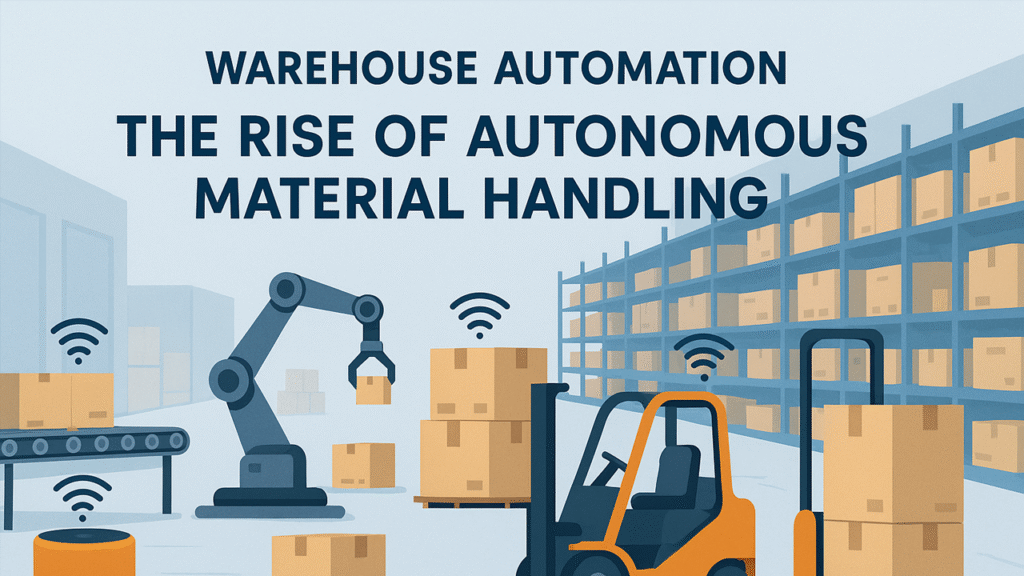
Warehouse Automation – The Rise of Autonomous Material Handling
Sponsored by
Robot Center – Buy Robot, Robot Buy, Robot Consultancy, Robotics Consultancy (https://robotcenter.co.uk)
Robots of London – Robot Hire, Robot Rental, Rent Robot, Hire Robot, Robot Events (https://robotsoflondon.co.uk)
Robot Philosophy – Robot Consultancy AND Robot Recruitment, Robot Advice, Robot Insights, Robot Ideas (https://robophil.com)
If you’d like to explore how autonomous material-handling robots can transform your warehouse operations, please call us on 0845 528 0404 or email sales@robotcenter.co.uk for a strategy call.
Introduction
In today’s fast-moving logistics and fulfilment landscape, the pressure is on. Customer expectations for rapid delivery, flawless fulfilment and low cost are higher than ever. At the same time, labour markets are tight, warehouse skills are evolving, and manual material-handling workflows are increasingly exposed as cost-centres rather than value-drivers.
Enter warehouse automation — specifically, autonomous material-handling robots (AMRs), automated guided vehicles (AGVs), robotic arms, goods-to-person systems and integrated software platforms. These technologies are no longer novel experiments: they are becoming core strategic assets for companies that want competitive advantage, resilience and scalability.
According to industry research, the warehouse automation market is growing strongly, with investments growing as companies look to relieve labour constraints and boost throughput. TGW Logistics+3McKinsey & Company+3NetSuite+3 Yet, while the potential is enormous, many projects don’t deliver the expected return unless they are properly planned, integrated, and aligned to business goals. McKinsey & Company
In this article we explore the rise of autonomous material handling: how it works, what the key technologies and trends are, what benefits and challenges lie ahead — and importantly how your business can capitalise on this trend. If you’re serious about transforming your warehouse, this is your roadmap.
What Do We Mean by Autonomous Material Handling?
“Material handling” in a warehouse includes all the movement, storage, control and protection of goods from receipt to dispatch. Traditional systems include conveyors, manual pallet-jacks, forklifts, static shelving and human labour for picking, packing and movement.
“Autonomous material handling” refers to systems in which robots or automated systems move goods with minimal human intervention. This includes:
Autonomous Mobile Robots (AMRs) that navigate warehouse floors dynamically, using LiDAR, cameras, SLAM and intelligent path-planning. Apex Warehouse Systems+3Alta Material Handling+3TGW Logistics+3
Automated Guided Vehicles (AGVs) that may follow predefined routes but are becoming more flexible. TGW Logistics
Automated Storage & Retrieval Systems (ASRS) and goods-to-person systems — robots bring items to human workers or to automated pack/work stations. NetSuite+1
Robotic picking/packing arms and autonomous pallet robots that handle variable SKUs, tote picking, palletising, etc. TGW Logistics+1
Integrated software platforms, WMS/ERP integration, IoT sensors and machine-learning systems that orchestrate robot fleets, optimise workflows, and enable adaptation. Automate
In sum, an autonomous material handling system is one where workflow from inbound goods through storage, picking, packing and outbound shipping is supported and optimised by robotic systems and software — rather than relying purely on human-driven manual operations.
Why the Surge in Adoption?
Here are the key drivers pushing companies toward autonomous material handling:
Labour pressure and cost
Labour shortages, rising wages and turnover in warehousing make manual handling less sustainable. Robotics can relieve reliance on manual tasks, reduce overtime, and stabilise labour costs. TGW Logistics+1
Speed, accuracy & fulfilment demands
End-customers expect faster deliveries, fewer errors and higher reliability. Robots can help achieve higher throughput, automate repetitive tasks, reduce picking errors and scale up for peak periods. NetSuite+1
Flexibility & SKU complexity
E-commerce means many SKUs, smaller orders, variable handling requirements. Traditional fixed automation or manual processes struggle with flexibility. AMRs and modular robots offer agility. TGW Logistics+1
Space utilisation & density
Robotic systems allow higher storage density (e.g., vertical retrieval, narrower aisles, dynamic storage) and improve use of warehouse footprint. McKinsey & Company+1
Data, intelligence & optimisation
Integration of IoT, AI and analytics means warehouses are becoming smarter. Real-time data about stock, flows, equipment availability and performance aids continuous improvement. Automate+1
Growth of automation market and maturity
The market size is growing rapidly. According to a 2025 survey, the automated warehouse equipment market reached about US $29.6 billion in 2024 and is projected to grow to over US $60 billion by 2031. Apex Warehouse Systems
Resilience & supply-chain security
Recent disruptions have emphasised the need for resilient operations. Automation helps buffer against labour disruptions, fulfilment variability and returns complexity. McKinsey & Company
Key Technologies & Trends in Autonomous Material Handling
Here are some of the most important technology themes to understand:
Autonomous Mobile Robots (AMRs)
AMRs are becoming “must-have” for material handling: they navigate autonomously, avoid obstacles, adapt to layout changes. Alta Material Handling+1
Artificial Intelligence, Machine Learning & Vision Systems
Picking robots, AMRs and material handling systems are increasingly leveraging ML and computer vision for item identification, path-planning, fault detection and adaptive picking. TGW Logistics+1
Collaborative Robots (Cobots) & Human-Robot Interaction
Rather than fully replacing humans, many systems are designed to collaborate — cobots working alongside warehouse workers to enhance productivity, safety and job-satisfaction. Automate
Robotics-as-a-Service (RaaS) & Flexible Deployment Models
Rather than large cap-ex investments, subscription models or robot-rental can provide lower-cost entry into automation. Automate
Cloud-based WMS, IoT and Real-Time Data Integration
Modern warehousing uses cloud-enabled WMS integrated with robot fleet management, IoT sensors and analytics to orchestrate the floor. Automate+1
Modularity and Scalability
Rather than “fixed automation” which can be hard to change, modular robot fleets, flexible layouts and scalable systems allow growth and evolution. TGW Logistics
Safety, Sustainability & Lifecycle Management
Automation also addresses safety (e.g., fewer accidents, heavy lifting by robots) and sustainability (energy-efficient robots, better space use). Apex Warehouse Systems
Real-World Benefits of Autonomous Material Handling
When executed well, warehouse automation drives tangible results:
Higher throughput: robots reduce travel time, increase picking/packing speed, optimise flows.
Better accuracy & lower error rates: automated systems reduce human error in picking and movement.
Reduced labour dependency: freeing human workers from repetitive tasks to higher-value roles.
Improved flexibility: ability to handle surges, variable SKUs, evolving business models.
Space savings & density gains: less wasted floor space, narrower aisles, vertical storage possible.
Better data & insights: through integrated systems, you can optimise operations, identify bottlenecks, forecast maintenance.
Improved safety & ergonomics: robots take heavy, dangerous tasks; fewer injuries, better worker satisfaction.
ROI and long-term cost savings: while upfront cost is high, the business case often strengthens over 3-5 years if planned properly.
As one industry article points out: “A warehouse automation revolution is underway … the overall automation market is growing rapidly and automation offers organisations the speed, reliability, flexibility and productivity their supply chains need.” McKinsey & Company
The Pitfalls & Why Many Projects Fail
Despite the benefits, automation isn’t guaranteed to succeed. Here are common pitfalls:
Poor alignment to business strategy: If automation is applied for technology’s sake rather than to solve a defined business problem, ROI suffers.
Under-estimating change management: New robotics change jobs, workflows and culture. Staff need training, roles must evolve.
Integration complexity: Robots must integrate with WMS, ERP, existing infrastructure. Without this the system becomes a silo. TGW Logistics+1
Ignoring flexibility & scalability: Fixed systems become obsolete when SKU mix or order profiles change.
Failing to plan for maintenance, lifecycle, system upgrades: Robots, sensors and software have ongoing costs.
Data & software deficiency: If the warehouse lacks data maturity, automation won’t deliver full value.
Underestimating cost and timeline: Automation still requires significant investment and time; over-promising leads to disappointment.
Neglecting human-robot collaboration: Ignoring the human factor can create friction, safety risks or wasted capacity.
As McKinsey warn: “many projects are not delivering the results.” McKinsey & Company
The Business Case: How to Approach Autonomous Material Handling
If you’re considering automation for your warehouse, follow a structured approach:
Define business objectives
What are you solving? Labour cost, throughput, error rate, fulfilment speed, peak flexibility?
Quantify baseline metrics and desired improvement.Map current workflows & pain-points
Inbound → putaway → storage → picking → packing → outbound.
Identify bottlenecks, travel times, error rates, idle resources.Build scenario modelling
Use simulation or emulation to test layout, robot fleet size, flow changes.
Account for SKU mix, seasonal peaks, growth.Choose the right technology stack
AMRs vs AGVs, picking arms vs goods-to-person, WMS integration, cloud vs on-prem.
Ensure scalability, modularity and future-proofing.Plan for integration & change management
Software integration, human training, role redesign, safety procedures.
Prepare floor-layout, power, data/IoT infrastructure.Define ROI and business model
CAPEX vs OPEX, payback period, lifetime cost, maintenance.
Consider RaaS or rental models if appropriate.Pilot/test & scale
Start small, measure results, iterate and scale up.
Use data to refine and justify further investment.Monitor and optimise continuously
Use analytics to optimise robot scheduling, layout, maintenance; adjust as business changes.Align culture and talent
Up-skill staff, create “robot-operator” or “robot-supervisor” roles, embed robotics literacy.
By following this disciplined path your warehouse automation initiative is far more likely to succeed and deliver real business value.
Why You Need Expert Help – And What We Offer
Given the complexity and importance of warehouse automation, business leaders cannot afford to go it alone. That’s where the consulting and recruitment dimension comes into play.
At Robot Center and associated brands we specialise in guiding companies through the full lifecycle of robotics deployment — from strategy and design, through vendor selection, integration, change management, to talent sourcing and ongoing optimisation.
What we deliver:
Strategic consulting: help you define objectives, build the business case, modelling and ROI analysis.
Automation roadmap: what technology to adopt, in what sequence, how to avoid pitfalls.
System integration support: software, hardware, vendor evaluation, layout planning.
Robot recruitment & training: sourcing skilled engineers, robot-operators, maintenance staff, ensuring you have the right human + robot team.
Change management and workforce transition: redefining roles, up-skilling staff, stakeholder buy-in.
Ongoing optimisation: once robots are deployed we help you tune workflows, monitor performance, scale the system.
Flexible models: hiring vs buying robots, rental, RaaS models and vendor servicing.
Why choose us:
We bring deep experience in robotics and logistics automation.
We combine consultancy, recruitment and operational support (no one-trick pony).
We are UK-based and understand the European/UK supply-chain context, regulations and business environment.
We work with you as a partner, not just a vendor — focusing on your business outcomes.
If you’re ready to explore how autonomous material handling can redefine your warehouse, call us today on 0845 528 0404 or email sales@robotcenter.co.uk to book your strategy consultation.
Key Use-Cases and Deployment Examples
Here are some common deployment scenarios where autonomous material handling brings major value:
Goods-to-Person Picking Systems
Instead of human pickers walking through aisles, robots bring shelves or totes to packing stations. This reduces picker travel time, increases throughput and improves accuracy. (See also automated storage & retrieval systems) NetSuite+1
Autonomous Transport of Pallets & Materials
Robotic trucks, tuggers, pallet trucks move pallets from inbound docks to storage, from storage to shipping, freeing forklifts and operators for higher-value tasks. Alta Material Handling+1
Hybrid Human-Robot Picking & Packing
Robotic arms pick and pack items, while humans perform oversight, exception handling and quality control — enabling high speed, low error, and flexible workflows. TGW Logistics+1
Flexible Fleet for Peak Demand
Instead of fixed conveyor systems, fleets of AMRs can be scaled up or down depending on seasonal demand, enabling cost-efficient fulfilment. Apex Warehouse Systems
Data-Driven Real-Time Optimisation
Robots generate operational data (paths taken, idle time, collisions, throughput) which integrates into analytics, enabling continuous improvement, predictive maintenance and smarter operations. Automate
What This Means for Your Business in the UK/Europe
As a UK business or European supply-chain operator, adopting autonomous material-handling robotics is no longer a niche or luxury: it is increasingly becoming a necessity to remain competitive.
Labour costs in the UK and EU are rising, and turnover in warehousing remains high: automation helps stabilise this.
E-commerce growth and consumer expectations (next-day, even same-day delivery) demand faster fulfilment cycles and error-free operations.
UK and EU companies face supply-chain pressures (Brexit, labour shortages, energy costs) – automation helps build resilience.
Sustainability pressure (ESG) is higher: optimizing energy, material movement, reducing waste and footprint matters. Automation supports these goals.
Innovation advantage: early adopters of flexible, autonomous systems will set the benchmarks; laggards risk losing cost-competitiveness.
For UK-based warehouse operators, logistics service providers (3PLs), retail distribution centres, manufacturing supply-chains, the time to act is now.
How to Get Started – Your Call to Action
Here’s how your next steps should look:
Pick up the phone and book a consultation with us: 0845 528 0404 or email sales@robotcenter.co.uk.
We’ll perform a high-level audit of your current warehouse operations (travel times, picking metrics, error rates, labour cost).
We’ll identify quick-win automation opportunities and longer-term strategic opportunities.
We’ll build a roadmap: what technology, what workflow change, what recruitment/training you’ll need.
We’ll help you evaluate vendor options, sourcing strategies and ensure you are ready for deployment.
We’ll partner with you through implementation and beyond — to ensure you get value and scale.
Don’t wait until your competitors have already locked in flexible, robotised fulfilment operations.
Conclusion
The rise of autonomous material handling marks a transformative moment for warehouse operations. With the convergence of AMRs, robotics, AI, cloud software, automatic picking and flexible systems, warehouses are no longer simply storage boxes but intelligent fulfillment hubs.
For businesses in the UK and beyond, embracing this shift isn’t optional if you want to remain competitive, reduce costs, scale with demand and deliver outstanding service. But success depends on more than buying robots: it requires strategic planning, workflow redesign, integration and the right talent.
That’s why partnering with experts like us at Robot Center, Robots of London and Robot Philosophy gives you the edge. With specialist consultancy, recruitment, strategy and execution support, we help you avoid the pitfalls, deliver the benefits and build the future of your warehouse.
Act now: Book your call on 0845 528 0404 or email sales@robotcenter.co.uk. Let us show you how autonomous material handling can drive your warehouse into the next generation of performance and productivity.
Sponsors recap
Robot Center – https://robotcenter.co.uk – Buy Robot, Robot Buy, Robot Consultancy, Robotics Consultancy
Robots of London – https://robotsoflondon.co.uk – Robot Hire, Robot Rental, Rent Robot, Hire Robot, Robot Events
Robot Philosophy – https://robophil.com – Robot Consultancy AND Robot Recruitment, Robot Advice, Robot Insights, Robot Ideas
We look forward to helping you build the warehouse of the future.
https://www.youtube.com/watch?v=giLOmu_x7Ow