




Why Oil & Gas Companies Are Turning to Autonomous Inspection Robots
The oil and gas industry is undergoing one of the biggest shifts in its history. For decades, the sector has relied on human expertise, heavy equipment, and rigorous safety protocols to explore, extract, and refine energy resources. But today, the industry faces mounting pressures: increasing operational costs, strict environmental regulations, the need for higher safety standards, and global demand for efficiency.
One solution is emerging at the forefront of this transformation: autonomous inspection robots.
In this article, we’ll dive deep into why oil and gas companies are rapidly adopting autonomous inspection robots, how these machines are reshaping safety and efficiency, and what opportunities exist for companies to embrace this technology. We’ll also explain how robot consulting services and robot recruitment solutions from Robot Center, Robots of London, and Robot Philosophy can help businesses not just keep up but lead the way.
📞 To book a call about how robots can transform your operations, contact us today at sales@robotcenter.co.uk or call 0845 528 0404.
The Current State of Oil & Gas Operations
The oil and gas sector is high-stakes by nature. From offshore rigs battered by storms to refineries operating under immense heat and pressure, conditions are harsh and dangerous. Workers are required to carry out routine inspections of pipes, tanks, subsea installations, and flare stacks—often in environments where a single mistake could have catastrophic consequences.
Traditional inspection methods often involve:
Manual climbing and rope access: Technicians scaling towers and rigs to visually inspect equipment.
Subsea diving operations: Divers descending hundreds of meters to assess subsea infrastructure.
Helicopter and drone surveys: Quick but costly aerial inspections of pipelines and flare stacks.
Shutdowns for safety: Entire facilities brought offline to allow for close-up human inspections.
These methods are costly, time-consuming, and dangerous. Companies lose millions each year through shutdowns alone, not to mention insurance costs and regulatory penalties when safety lapses occur.
The Rise of Autonomous Inspection Robots
Autonomous inspection robots are designed to operate where humans can’t—or shouldn’t—go. Unlike traditional robots that require direct control, autonomous systems leverage AI, machine vision, and advanced mobility to navigate and analyze environments independently.
Types of autonomous robots being deployed in oil and gas include:
Crawling robots: Designed for inspecting pipelines and confined spaces.
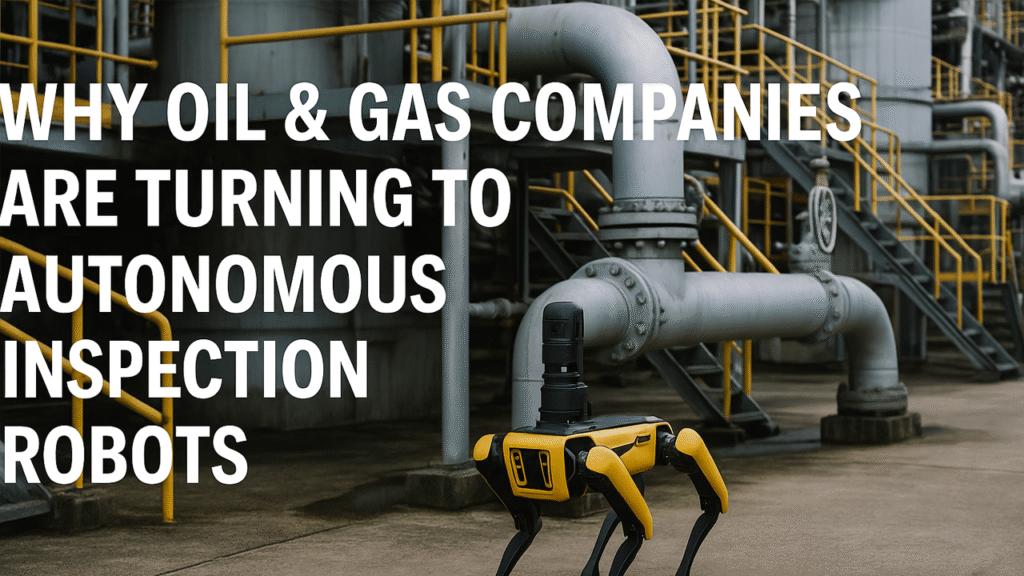
Quadrupeds (“robot dogs”): Agile robots capable of navigating complex terrains, including offshore rigs and refineries.
Aerial drones with autonomy software: Capable of long-duration, pre-programmed inspection missions.
Subsea robots (AUVs & ROVs): Used for inspecting subsea pipelines, risers, and drilling infrastructure.
Digital signage and communication robots: Deployed at facilities to guide, monitor, and interact with staff.
These robots are not just replacing human inspectors—they are amplifying human capabilities by providing 24/7 monitoring, richer datasets, and predictive maintenance insights that were previously impossible.
Why Oil & Gas Companies Are Adopting Robots
1. Safety First
Safety is paramount in oil and gas. Robots reduce the need for human entry into hazardous environments, lowering accident risks and fatalities. A quadruped robot can inspect a flare stack while it’s still live, eliminating the need to shut it down and send humans into harm’s way.
2. Reducing Costs
Autonomous robots significantly cut inspection costs by:
Reducing downtime from shutdowns.
Lowering insurance premiums by improving safety records.
Performing inspections faster and more accurately.
3. Boosting Efficiency
Robots can work 24/7, collect more data than humans, and feed insights into predictive maintenance systems. The result: fewer failures, longer asset life, and more efficient operations.
4. Regulatory Compliance
Governments are tightening regulations on safety and environmental performance. Robots allow for frequent, non-intrusive inspections that ensure companies stay compliant without interrupting operations.
5. Sustainability Goals
With increasing pressure to cut emissions, robots are enabling oil and gas companies to track methane leaks, monitor emissions, and ensure equipment is running efficiently—all critical to environmental sustainability strategies.
Real-World Case Studies
Equinor: Deploying Robot Dogs Offshore
Equinor, a global leader in offshore energy, has deployed Spot, the quadruped robot developed by Boston Dynamics, to inspect rigs in the North Sea. The robot autonomously patrols hazardous areas, checks gauges, and streams live video back to operators onshore.
Shell: Subsea Inspection with Autonomous Vehicles
Shell has invested in autonomous underwater vehicles (AUVs) that can travel vast distances inspecting subsea pipelines. These robots cut inspection costs by up to 50% compared with traditional ROV and diver-based methods.
BP: Drone-Based Methane Detection
BP uses autonomous drones equipped with methane sensors to detect leaks across its global facilities. This improves compliance, cuts emissions, and enhances corporate ESG performance.
Barriers to Adoption—and How to Overcome Them
While adoption is accelerating, some companies are still hesitant. Common challenges include:
High upfront costs: Robots are an investment, but long-term savings outweigh initial expenditure.
Skills shortage: Few oil and gas companies have in-house robotics expertise.
Integration complexity: Robots need to work seamlessly with existing systems and workflows.
Cultural resistance: Human workers may initially see robots as a threat.
This is where robot consulting and recruitment services play a critical role.
How Robot Consultancy Helps
At Robot Center, Robots of London, and Robot Philosophy, we provide end-to-end consulting services to help oil and gas companies adopt robotics successfully.
Our consultancy covers:
Strategy Development – Identifying where robots can deliver the most ROI.
Technology Selection – Choosing the right robots for specific inspection tasks.
Integration Support – Ensuring robots connect with existing asset management systems.
Pilot Projects – Running trial deployments to prove value before scaling.
Ongoing Optimisation – Continuously improving performance with AI-driven insights.
By working with a consultant, oil and gas companies reduce risk, speed up adoption, and maximise the benefits of robotics.
📞 To book a consultation, email sales@robotcenter.co.uk or call 0845 528 0404.
Robot Recruitment for Oil & Gas
One of the biggest hurdles to robot adoption is the skills gap. Oil and gas companies need:
Robotics engineers
AI and data specialists
Field technicians with robotics training
Project managers with cross-industry expertise
At Robot Philosophy, we specialise in robot recruitment, sourcing top talent for the oil and gas sector. We understand both the robotics industry and the energy sector, ensuring candidates are technically skilled and culturally aligned.
If your company needs the right people to manage your robotic transformation, we can help.
The Future of Robotics in Oil & Gas
Over the next decade, we’ll see:
AI-powered predictive maintenance where robots not only inspect but also anticipate and prevent failures.
Swarm robotics for simultaneous inspection of massive sites.
Digital twins updated in real-time by autonomous robots.
Full automation of hazardous inspections with minimal human involvement.
Robots as standard practice, not experimental technology.
Companies that embrace robotics now will lead the industry tomorrow. Those that don’t risk falling behind competitors who achieve safer, cheaper, and more sustainable operations.
How We Can Help You
We don’t just sell robots—we make them work for your business.
Robot Center – Buy robots, access expert consultancy, and optimise your operations.
Robots of London – Hire or rent robots for events, short-term projects, or pilot schemes.
Robot Philosophy – Specialist robot consultancy and recruitment services for the oil and gas sector.
📞 Ready to explore how robots can transform your inspection processes? Contact us at sales@robotcenter.co.uk or call 0845 528 0404 today.
Conclusion
Oil and gas companies are turning to autonomous inspection robots because they deliver what the industry needs most: safety, efficiency, compliance, and sustainability. The shift is no longer a question of “if” but “when.”
By partnering with trusted consultants and recruitment specialists, companies can accelerate their robotics journey, reduce risks, and unlock massive value.
The oil and gas industry has always been about bold innovation. Autonomous inspection robots are simply the next step in that tradition—and those who act now will lead the way into a safer, smarter, and more profitable future.
Sponsored by:
Robot Center – https://robotcenter.co.uk/ | Buy Robot, Robot Buy, Robot Consultancy, Robotics Consultancy
Robots of London – https://robotsoflondon.co.uk/ | Robot Hire, Robot Rental, Rent Robot, Hire Robot, Robot Events
Robot Philosophy – https://robophil.com/ | Robot Consultancy AND Robot Recruitment, Robot Advice, Robot Insights, Robot Ideas
📞 Book a call today: sales@robotcenter.co.uk | 0845 528 0404
https://www.youtube.com/watch?v=2SgvJ9JwpxY
https://www.youtube.com/shorts/GJB3gdeN3Xk